What Should the Grown-Ups Eat in Year One? Food for Staying Upright
Part three of the sleep-deprivation series. In part one we learned that gaining weight on no sleep is the spec, not a character flaw. In part two we dug a defensive line in the kitchen: protein, iron, and the hot pot.
Today we go one layer down. In the first year with a baby, what should the adults actually be eating?
Up front: I'm not a nutritionist. I am, however, a father who has stood in an infant-era kitchen twice now. The official numbers below come from the sources listed at the end.
Setting the Target: "Don't Collapse" Beats "Get Slim"
A household with an infant is a system that barely runs with both adults operating. One of them goes down, and it's checkmate immediately.
So the top-priority goal for food in this period isn't your waistline — it's uptime. Dieting will still be there once the baby sleeps through the night.
As I wrote in part one, a sleep-deprived body drifts toward sugar and fat if you leave it alone. The point of this post is to set up a decent baseline so that the drift doesn't end with ice cream and potato chips being the entire day's intake.
Breastfeeding Moms Get an Extra 350 kcal
This is an official number, and it's surprisingly little-known.
Japan's national Dietary Reference Intakes put the added energy requirement during lactation at roughly +350 kcal per day, and added protein at +20 g per day. Making breast milk is a job, and that's what the job costs.
Which means that being hungry while breastfeeding is a normal status report, not a discipline problem. Cutting your food intake because you just gave birth is like running a long distance while throttling the fuel line. For the body-shape question, the logic from parts one and two (sleep, and the kitchen defensive line) is enough.
As for what those 350 calories should be made of: something leaning toward "staple carb or protein" — an onigiri rice ball plus a boiled egg, or yogurt plus a banana — does more work than a sweet pastry. For the iron side of things, see part two.
Drink Before You're Thirsty
Breast milk is mostly water. Every feed sends a meaningful volume of fluid out of the body.
So while breastfeeding, waiting until you feel thirsty is already a bit late. Our system was to keep two pitchers of mugicha (roasted barley tea) chilling at all times, and a water bottle parked next to wherever the feeding happened.
A rule as crude as "one glass before the feed, one glass after" is enough to keep the whole thing running.
Caffeine and Alcohol, Realistically
Sleep-deprived adults lean on coffee. Leaning is allowed — just watch the amount and the timing.
For caffeine while breastfeeding, Japan has no single unified standard, but overseas guidance generally lands around 200–300 mg per day — roughly two cups of coffee. If you're going to have it, having it right after a feed puts the most distance between the coffee and the next feed, which is reassuring.
Dads aren't off the hook either. Caffeine after late afternoon further degrades the quality of a night's sleep that is already chopped into pieces. Keeping it light after 3 p.m. is the safe play. This is a field report from a man who kept pouring coffee into the peak of his drowsiness and regretted it at night.
Alcohol passes into breast milk, so the general guidance is to avoid it while breastfeeding. For your individual circumstances, ask a midwife or your pediatrician. As usual, I am gracefully punting this one to the professionals.
The No-Shame Shortcut List for Days You Can't Stand in the Kitchen
Here's our actual working list, so that none of the above gets nullified by "I don't have the energy to cook."
- Protein that needs no stove: natto (fermented soybeans), tofu, canned mackerel, canned tuna, boiled eggs (do a batch at once), cheese. Opening a container is enough to hold the line.
- Frozen vegetables: spinach, broccoli, fried eggplant. Nutritionally fine, and neither the knife nor the cutting board has to come out.
- Cook extra rice and freeze it: simply having a staple carb in the house lowers the odds that your judgment-free 2 a.m. self spends money on something unnecessary.
- Prepared deli food, retort pouches, and delivery are "paying money for sleep": no guilt required. As we established in part one, sleep does more for your weight anyway.
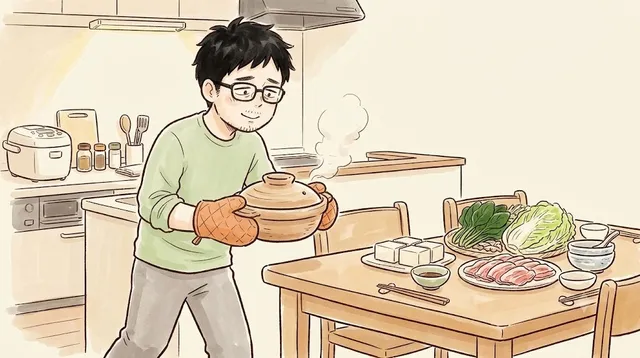
- When in doubt, nabe (hot pot): see part two.
[My Take] It Starts With Giving Up on "Cooking Properly"
Meals in the infant year stabilize in the households that stop trying to cook properly.
Rice, a miso soup or hot pot with lots of stuff in it, and some protein that doesn't need a stove. That alone is enough to keep the adults standing.
A diet that keeps going beats a diet that's perfect. Three posts in a row have now landed on the same conclusion, so I assume that's the answer this series was looking for.
Wrapping Up
In the infant year, the adults' food goal is "don't collapse." While breastfeeding, add 350 kcal and add fluids; keep coffee to about two cups; treat shortcuts as strategy.
For the record, the drink next to me as I write this is barley tea. The time is well past midnight. I've grown.
Sources
- Dietary Reference Intakes for Japanese (2020) — additional requirements for lactating women (MHLW, in Japanese)
- Caffeine intake during pregnancy and breastfeeding (Obstetrics & Gynecology Online Journal, in Japanese)
- On caffeine intake (Japan Human Milk Bank Association, in Japanese)