If Your Baby Cries the Second You Sit Down, Get Up and Walk
For a long time, our house had an unexplained phenomenon in it.
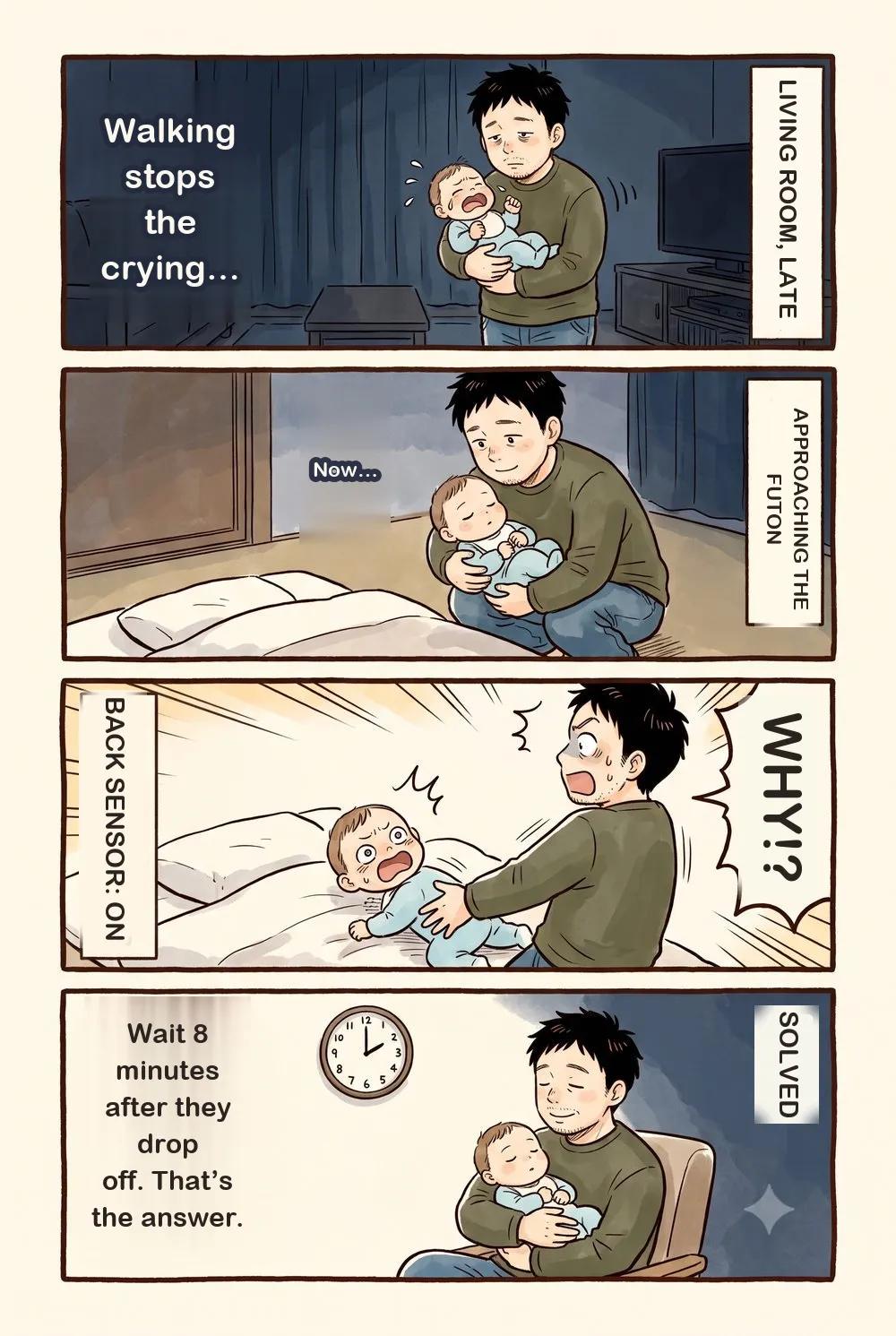
Pick up the crying baby, walk around, and the crying stops. So far, so good. The problem is the moment you get tired and sit down on the sofa.
Crying.
Same person, same grip, same arms. The only variable that changed was whether I was walking.
I assumed our kid was just a tough customer. Nope. This has a name — the transport response — and a Japanese research team has studied it properly.
What the "transport response" actually is
In 2013, a team led by Kuroda Kumi published a paper in the international journal Current Biology.
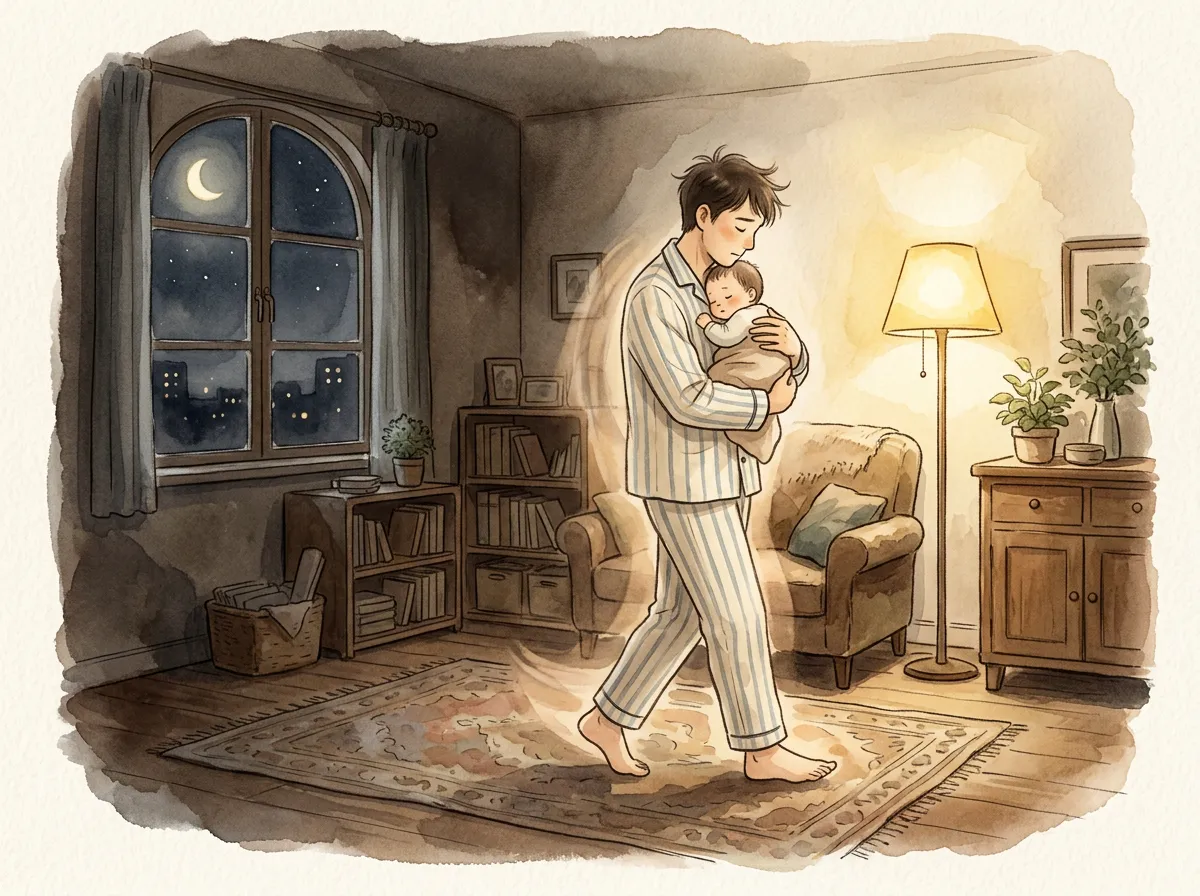
They compared babies under 6 months old across three conditions: lying in a bed, held by a seated mother, and carried by a walking mother. Only when they were carried while the mother walked did the babies stop crying, stop moving voluntarily, and — here's the part that got me — show a drop in heart rate.
Sitting and holding didn't produce the response. Our sofa situation, it turns out, is in the literature.
The fun part is that the same thing happens in mouse pups. Picked up and carried, they go quiet and pull their bodies in tight. So this isn't a human-baby quirk — it looks like a mechanism shared broadly across mammals.
仮説仕組みからの推測HYPOTHESISInferred from mechanism
Why we'd be built this way (hypothesis territory from here)
You know how a kitten goes limp and stops squirming when it's picked up by the scruff of the neck? Same general neighborhood.
When a parent picks a child up and moves, a child who isn't thrashing around is easier, faster and safer to carry. Researchers read this as the baby cooperating with being carried. In the mouse experiments, interfering with this response meant the mother had to spend extra effort retrieving her pups.
Now, a caveat, properly stated.
The "they go quiet so predators won't find them" explanation is tidy and fun, and it does come up in the research. But nobody has demonstrated that a human baby's brain is detecting predators and hushing up. It's an evolutionary hypothesis.
The accurate phrasing is closer to: this appears to be a response mammals have inherited that makes being carried by a parent go more smoothly. Not frozen in fear — helping out. As a parent, I find that a lovely thing to know.
In practice: walk 5 minutes, then sit 5–8 minutes
In 2022, the same team published the obvious follow-up study: can we actually use this to get babies to sleep? They compared four conditions with crying babies — being carried while the parent walks, being held by a seated parent, being moved in a cot, and simply being laid down.
- Carried while walking for 5 minutes straight, every crying baby stopped crying. About 45% of them fell asleep in the process.
- Just sitting and holding doesn't work well on a baby who is mid-cry. The movement was the essential ingredient.
- Once they're asleep, don't put them down right away. Sit down, keep holding them for 5–8 minutes, and then lay them down — they were less likely to wake up.
The trick with those five minutes, apparently, is not to stop partway. Steady pace, just keep walking. A dad doing laps of the living room is a ridiculous sight, but this is, quite literally, the behavior described in the paper. Lap with pride.
The back switch was never in the back
This is the finding that made me go "ohhh, so that's what's happening."
Babies wake up not at the moment their back touches the mattress, but at the moment the contact with the parent's body starts to come apart.
Which means that as you begin lifting your upper body away for that slow, delicate lowering, the match is already decided. There was never a sensor in the mattress.
Since learning this, I've stopped trying to perfect my put-down technique. The thing actually worth practicing was the patience to sit there and wait.
What not to do, and what to keep in mind
- Don't run. What was tested is ordinary walking. Going faster doesn't make it work better, and it increases both the risk of falling and the jostling to the baby's head. Calm pace, solid support.
- Once they're asleep, put them on their back on a firm, flat sleep surface. Carrying is a way to stop the crying, not a place to leave a baby sleeping. And settling a baby in a carrier is dangerous if the parent nods off too.
- If 5–10 minutes of walking doesn't stop the crying, suspect that something is wrong physically. Something may hurt — an ear infection, for example. The research team themselves recommend getting the baby seen.
- This is a small study. It covered 21 pairs with babies under 7 months old — and mothers only. It is not a spell that works on every baby.
That last point matters enough to say twice: if you try this and your baby doesn't sleep, it doesn't mean you're bad at holding your baby.
[My take] "When in doubt, walk" was right all along
The thing I'd been doing in the middle of the night — drifting around the room like a ghost with no idea why — now has a name and evidence attached to it.
And it isn't only me being gentle with them. The baby, apparently, is switching into "being carried" mode and meeting me halfway. Thinking of it as teamwork makes the midnight laps feel a little more worthwhile.

にじパパTRANSMISSION
So all that ghostly midnight circling of the living room? It was a joint project between me and the baby.
In summary
Walk for 5 minutes, sit for 5–8 minutes, then put them down. The true identity of the "back switch" isn't the back — it's the moment you start to pull away.
Also worth noting: the night after I learned this sequence, I was the one who got sleepy first, mid-lap. Maybe the transport response survives into adulthood.
Sources
- The science of calming babies and settling them to sleep (RIKEN press release, 2022, in Japanese)
- Infant calming responses during maternal carrying in humans and mice (Current Biology, 2013)
- The science of calming babies and settling them to sleep — it wasn't the back switch (The Physiological Society of Japan, in Japanese)