"Calm" and "Asleep" Aren't the Same Thing: Splitting Bedtime Into Four Problems

にじパパTRANSMISSION
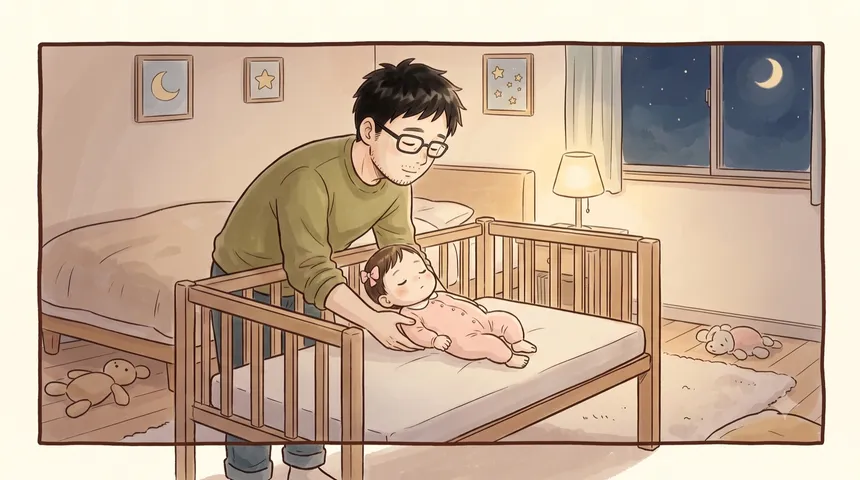
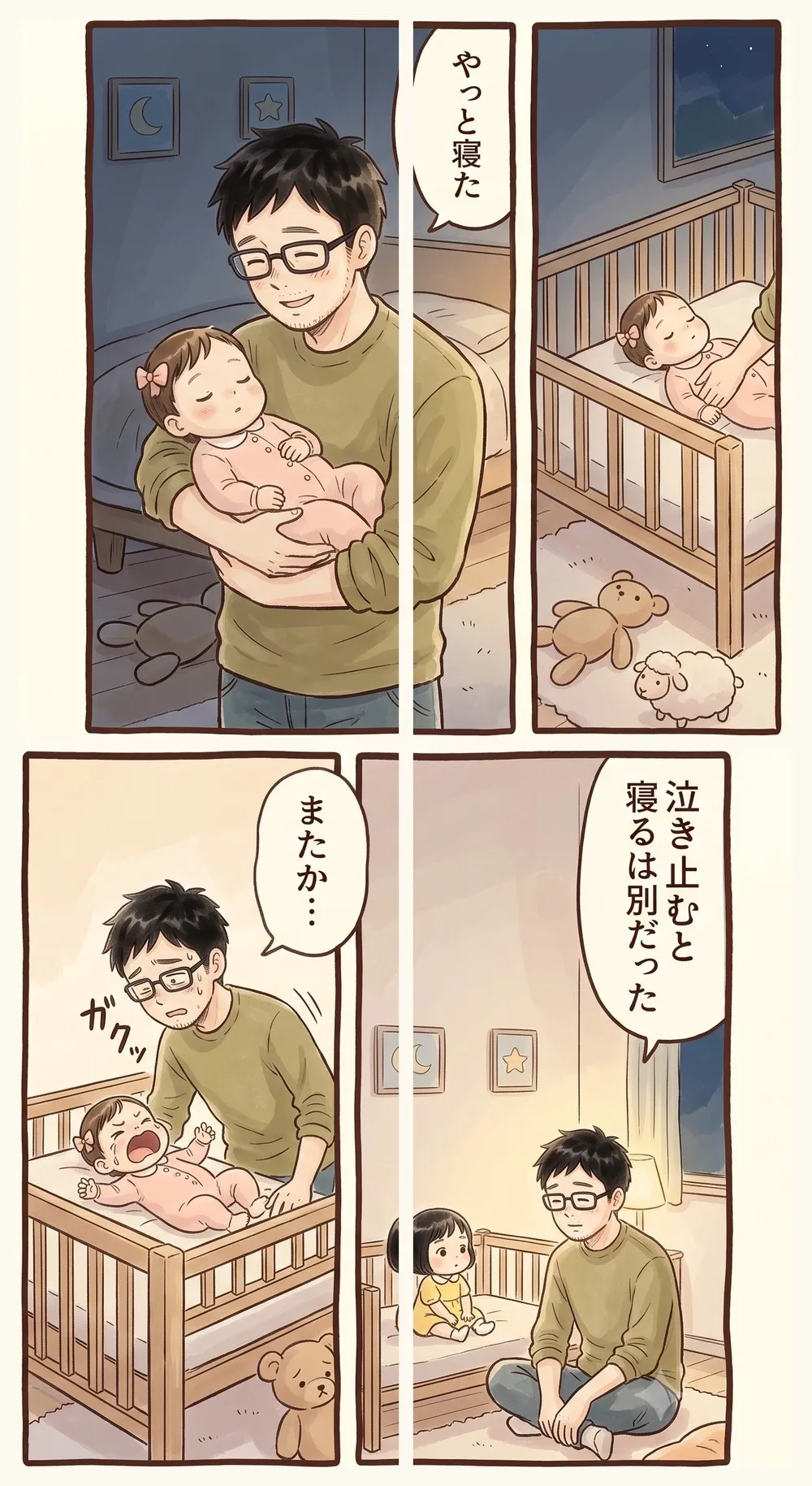
Finally asleep… I think. I lay her down. She cries.
I lost count of how many times a day I did this.
Calm in my arms. Breathing settled. Surely asleep. Lay down. Cry.
For a long time I filed this under "I'm bad at getting her to sleep." I wasn't. I'd made a category error: I thought "calm" and "asleep" were the same thing. They aren't.
Bedtime was never one problem
The reframe that helped most: bedtime has at least four separate goals.
- Calm (soothe distress or fussing, right now)
- Fall asleep (shorten the time to sleep onset)
- Stay asleep (fewer night wakings / longer total sleep)
- Sleep safely (airway stays clear while asleep; no suffocation risk)
The catch is that a method that works for the first goal won't necessarily work for the second or third. Walking while carrying, for instance, is useful for calming — but it doesn't make a baby sleep through the night. In fact, a trial that increased carrying time in early infancy reduced crying and fussing but did not significantly increase sleep.
As long as you're hunting for the one magic method, you probably won't find it. Decide first which of the four you're actually trying to solve, and the tool follows.
A place to calm is not a place to sleep
Here's the other split — and this one matters for safety.
The places where a baby will fall asleep come in two kinds: a place to calm them while a caregiver is awake and watching, and a place designed for sleep, where the caregiver may sleep too. These are not the same.
Arms, carriers, strollers, car seats, powered swings — plenty of babies fall asleep in these. But they belong to the first kind: places to calm. They may be inclined, may let the chin drop toward the chest in a seated posture, may have straps or fabric near the face.
A study collecting infant deaths that occurred in sitting devices (car seats and the like) in the US found that most happened when the device was used other than for its intended travel purpose — left sleeping in the seat after arrival, used as a makeshift bed at home. A case series can't give an incidence rate, but it's no argument for "they're asleep, so leave them there."
So the principle is simple. Once asleep, move the baby as soon as you can to a firm, flat, bare infant sleep surface, on the back. A car seat is necessary to protect against crashes while driving, and yes, babies fall asleep on the road — that happens. The problem is continuing to let them sleep in the seat after you've arrived. (How to build the safe sleep surface itself is a separate post.)
So work through it in order
Four goals, two kinds of place. With those in mind, the safer way through the night is to escalate in order rather than pile on ever-stronger stimulation.
- Check the cause. Hunger, diaper, burp, warmth, clothing. If there's labored breathing, fever, poor feeding, or dull responsiveness, don't treat it as a bedtime-technique problem — get it medically checked.
- Start low-stimulation. Hold, speak softly, sing, dim the lights.
- If still crying hard, walk briefly while carrying, in a safe space (that's the "transport response," which has its own post). Even once asleep, hold for a few minutes before laying down, and they're less likely to wake the instant they touch the mattress.
- Once asleep, to a firm flat surface (section 2).
- If you're sleepy, unsteady, or feel anger — stop there. Put the baby down on their back in a safe sleep space and step away for a few minutes. Ask for a handoff. This isn't a lack of effort; it's the safest call available.
The WHO also advises against keeping a baby under one restrained for more than an hour at a time in a stroller, carrier, and the like. It isn't a bedtime-specific study, but it's a general backing for "don't keep them fixed in place for long."
The Takeaway
I wasn't bad at bedtime. I was treating it as one problem when it was four. Calm, fall asleep, stay asleep, sleep safely — split them, decide which one you're solving, and once they're asleep, move them to a flat surface. If you've hit your limit, put the baby down and step away instead of holding on.
Just that cut down a lot of the nightly wandering.
As for the "cries the instant I lay her down" problem — it has a name and a fix. That's the next post.
More from Nijipapa's "Evidence-Based Parenting" series
- If Your Baby Cries the Second You Sit Down, Get Up and Walk
- It Never Said "Stop Co-Sleeping": Building a Safe Sleep Environment (A Serious One)
- Swaddling and White Noise Worked — But Each Has a Point Where You Stop (bedtime series #2)
- Bouncing Squats and Car Rides Have Almost No Evidence — Plus the "Where They Fell Asleep" Trap (bedtime series #3)
- All My 3 a.m. Searching Left Me Was Anxiety: A Reading Order for Parenting Information
- Browse the full "Evidence-Based Parenting" series
Note: this post introduces published research and official resources; it is not a substitute for diagnosis or treatment. For your sleep setup or any symptom that worries you, please talk it through at a checkup or with your pediatrician.
Main sources: the AAP policy statement and technical report on safe sleep (2022 update); the WHO Guidelines on Physical Activity, Sedentary Behaviour and Sleep for children under 5 (2019); a case study of infant deaths in sitting devices in the US (Liaw et al., 2019); and the Children and Families Agency's safe-infant-sleep guidance. For more, see the Children and Families Agency and the WHO.