Swaddling and White Noise Worked — But Each Has a Point Where You Stop

にじパパTRANSMISSION
Leaning on gadgets felt like cheating. Turns out the ones that work, work.
Last post, I split bedtime into four goals: calm, fall asleep, stay asleep, sleep safely. This one covers three tools with research behind them, mostly for falling asleep and calming.
But let me be upfront: each of these can turn dangerous if you get the "when to stop" or the "how" wrong. Precisely because they work, that part matters.
Swaddling: it works. The stopping point matters most
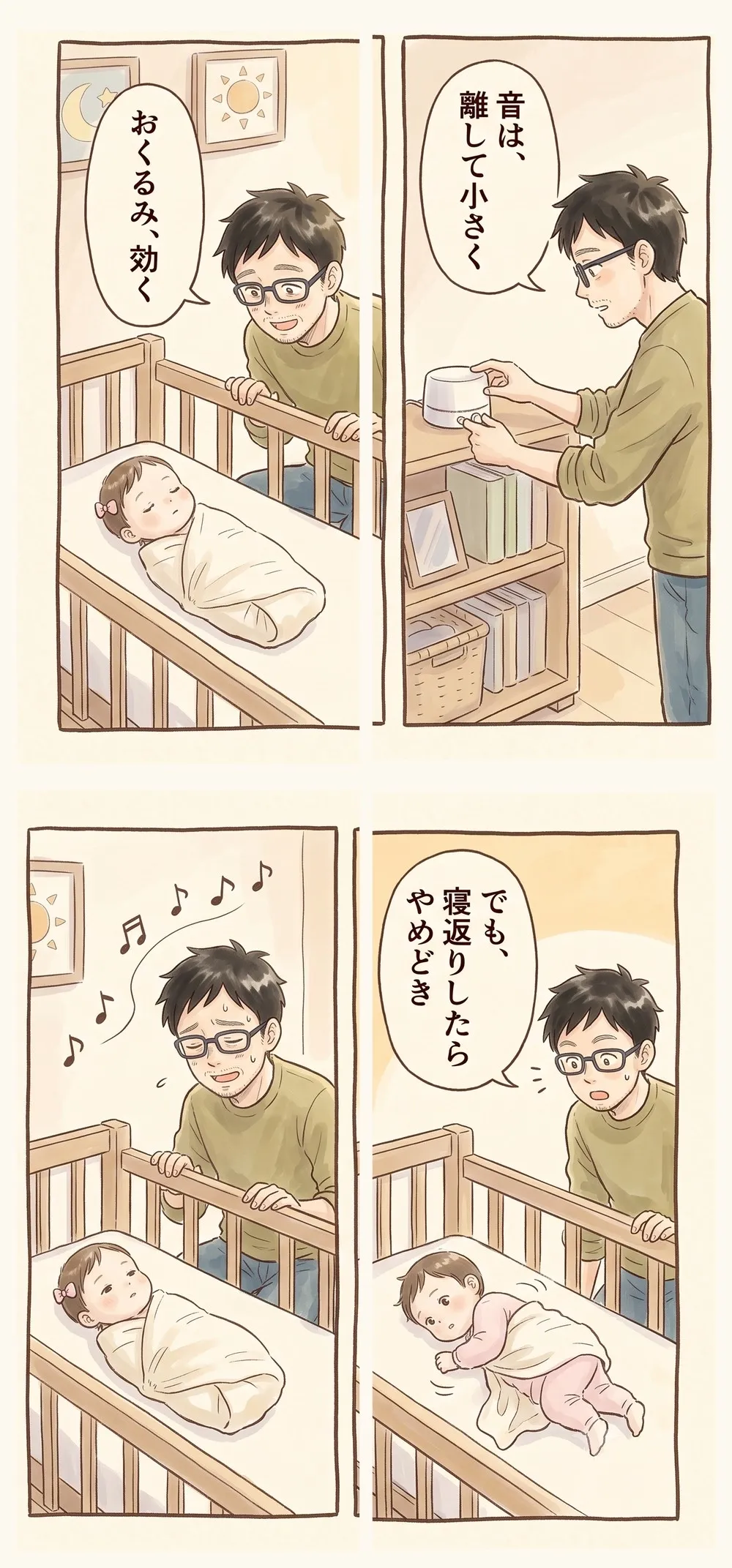
Swaddling wraps the upper body in a thin cloth to dampen the startle (Moro) reflex.
A systematic review finds it can reduce arousals and crying and lengthen sleep. In the newborn stretch, it's a tool you can genuinely feel working.
But the same review notes that, depending on the wrap, it changes the risk of overheating, respiratory infection, and effects on hip development. The conditions for safe use are clear.
- Always on the back. A swaddled baby who ends up prone or on their side is at much higher risk.
- Hips and knees free. Don't bind the legs straight and tight. Leave room for the "M" position — hips and knees bent, thighs supported.
- Don't overheat. Don't wrap over heavy clothing. Don't cover the head.
- And most important — stop the moment they start trying to roll.
有力単一の研究・限られた条件EMERGINGOne study · narrow conditions
Swaddling's effect is supported by a systematic review, but it varies by method and study. It's a conditional "strong" — "in the newborn period, done correctly" — and shouldn't be extended to older babies or to a baby who has started rolling.
Rolling comes with development, not a fixed month. For many families the "stop now" call arrives within the first few months. And there's no basis for treating a weighted swaddle or sleep sack as a safe substitute.
White noise: it works. Watch volume and distance
White noise is a steady, broadband "shhh" that masks sudden sounds.
It's an old, small trial, but in 40 newborns aged 2–7 days, 80% fell asleep within five minutes with white noise, versus 25% in the silent control. That's where the "may help with sleep onset" claim comes from.
The catch is the sound itself. A study measuring consumer infant sound machines found that some, at maximum volume and close range, reached sound-pressure levels you don't want near an infant's hearing.
有力単一の研究・限られた条件EMERGINGOne study · narrow conditions
The sleep-onset help is limited to a small trial, and overnight use and long-term development weren't assessed. You can say "may help them fall asleep sooner," not "fine to leave on all night."
So if you use it, the conditions are:
- Not by the head or inside the crib. Keep it across the room.
- Low enough that it doesn't drown out conversation.
- Use a timer, only as long as needed. Not on all night.
There's no single "safe volume number" that applies to every machine, room, and distance. So "far, quiet, short" is how you stay on the safe side.
Lullabies: probably work — and live singing is the strong version
The last one needs no gadget.
In a study of babies under one year old, hearing a lullaby from an unfamiliar language and culture still lowered arousal indicators — heart rate, skin response — more than a non-lullaby song did. Something in the way lullabies are built seems to settle babies.
仮説仕組みからの推測HYPOTHESISInferred from mechanism
What the study showed is that arousal indicators dropped — not what fraction actually fell asleep, or whether night wakings decreased. Read it as "lullabies may work toward calming," a direction rather than a proof.
The interesting part: live singing makes more sense than a recording. A live voice carries not just melody but timing, breath, and adjustments to the baby's own reactions. Recorded music (there is NICU research) doesn't yet generalize cleanly to bedtime for a healthy baby at home.
It's also low-pressure because being bad at it is fine. My off-key lullabies settle our kid well enough. What's working is probably not the tune — it's that it's the usual voice.
The Takeaway
Swaddling, white noise, lullabies. Among bedtime tools, these three are unusual in having research behind them. But precisely because they work, the "how" and the "when to stop" are what matter. On the back and stop at rollover; sound far, quiet, and short; sing live even if you're bad at it.
The idea that "leaning on tools that work is cheating" was probably just my own hang-up. Keep to the conditions, and it's fine to lean.
The hardest part of keeping to the conditions is late at night, when you're sleepy too. That's not a tool problem.
More from Nijipapa's "Evidence-Based Parenting" series
- If Your Baby Cries the Second You Sit Down, Get Up and Walk
- It Never Said "Stop Co-Sleeping": Building a Safe Sleep Environment (A Serious One)
- "Calm" and "Asleep" Aren't the Same Thing: Splitting Bedtime Into Four Problems (bedtime series #1)
- Bouncing Squats and Car Rides Have Almost No Evidence — Plus the "Where They Fell Asleep" Trap (bedtime series #3)
- All My 3 a.m. Searching Left Me Was Anxiety: A Reading Order for Parenting Information
- Browse the full "Evidence-Based Parenting" series
Note: this post introduces published research and official resources; it is not a substitute for diagnosis or treatment. If you're unsure about how to swaddle or how to use a device, please discuss it at a checkup or with your pediatrician.
Main sources: a systematic review of swaddling (van Sleuwen et al., 2007); a meta-analysis of swaddling and SIDS (Pease et al., 2016); a trial of white noise and sleep onset in newborns (Spencer et al., 1990); a study of sound-pressure levels of infant sleep machines (Hugh et al., 2014); infants' responses to unfamiliar foreign lullabies (Bainbridge et al., 2020); and the AAP policy statement on safe sleep (2022 update). For more, see the Children and Families Agency.