Bouncing Squats and Car Rides Have Almost No Evidence — Plus the "Where They Fell Asleep" Trap

にじパパTRANSMISSION
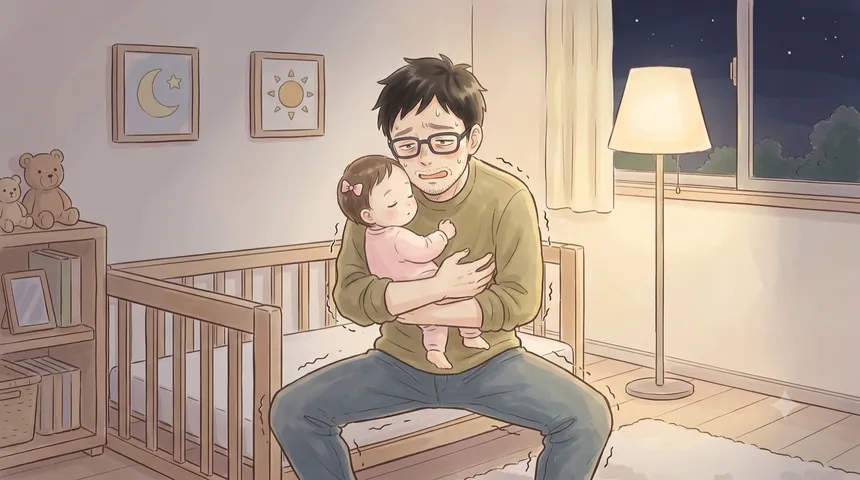
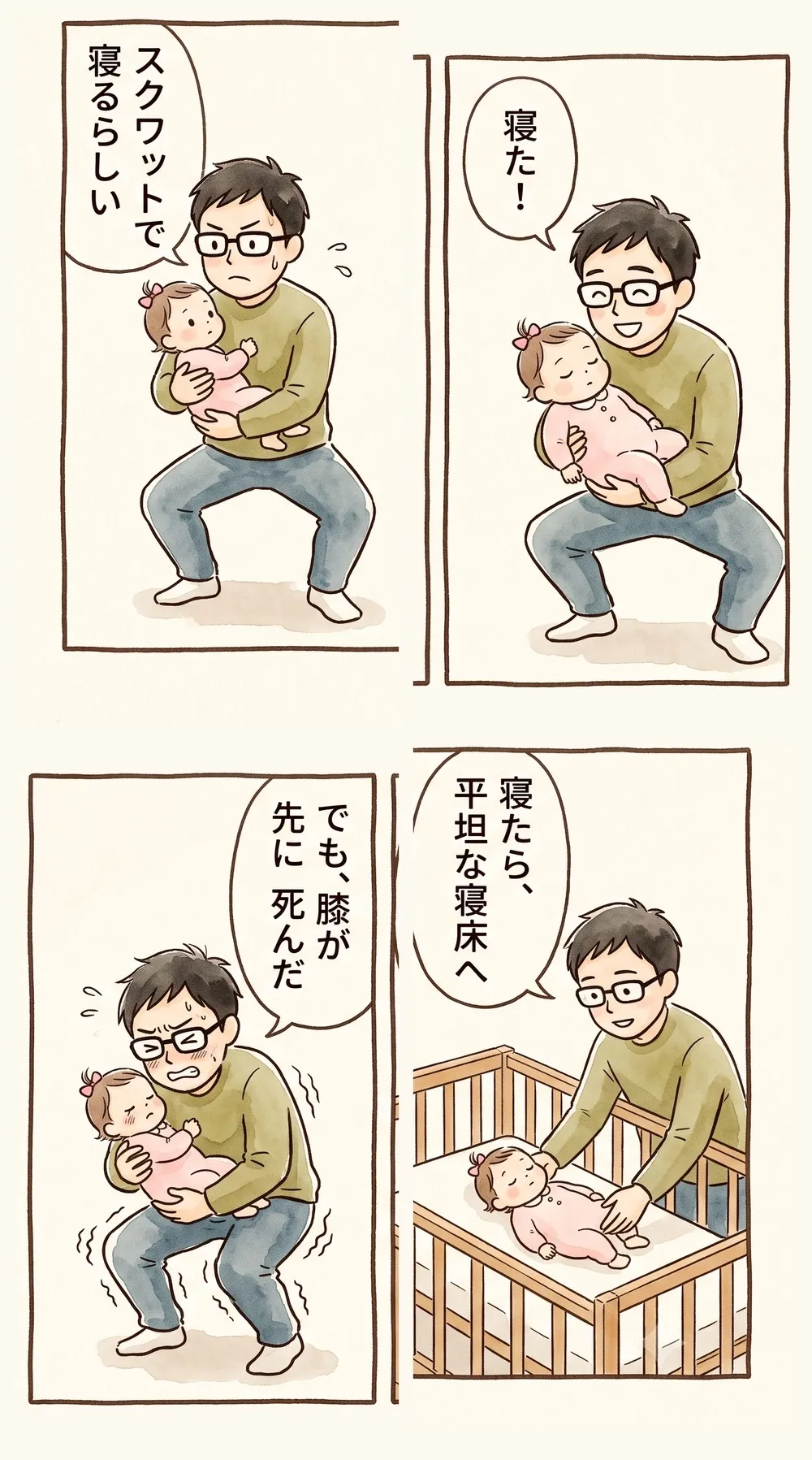
"Do squats, she'll go out like a light." She did. My knees went first.
In the first post of this series I said there's probably no single magic method. This one looks at the other side — how well the internet's "go-to" methods have actually been checked.
Bottom line up front: the most popular methods have the thinnest direct evidence.
I went looking for the "evidence" on squats, birth balls, and driving
Japanese parenting blogs and forums swear by bouncing squats, knee dips, walking the stairs, bouncing on a birth ball, and driving a loop in the car. We tried all of them.
The problem: I couldn't find a controlled trial checking any of these against an infant-sleep outcome. Not even one comparing repeated squats to plain walking.
Forum reports have a bias: successes get posted. The nights it failed, the nights you quit halfway, the nights something else (a feed, the hour, sheer exhaustion) was doing the work — those don't get written up. Ages, illnesses, and the definition of "success" are all over the place. It can't be used to judge effect.
仮説仕組みからの推測HYPOTHESISInferred from mechanism
Bouncing squats, birth-ball bouncing, and the sleepy car ride sit at "hypothesis" — almost no direct trials. Not proven ineffective; simply unchecked. Forum reports help you see what families are trying, but they aren't evidence of effect.
"No evidence it works" is not "evidence it doesn't." Some babies may settle this way. It's just not a reason to keep doing an unverified method in a form that strains your body.
If you do it, minimize the risk
Untested or not, sometimes you want to. You're tired and desperate. So instead of "don't," here's the lower-risk version.
- No deep dips, no fast bouncing. Keep it to a small shift of weight.
- Not with eyes closed, on stairs, or on a slippery floor. Only within a range where you can stand steadily without leaning on a wall or rail.
- Not if your pelvis, knees, or back hurt postpartum. That's exactly what repetitive motion breaks first.
- Lower-risk alternatives: rock your torso slowly while seated / walk briefly on a safe, support-free floor / hand off to someone else.
This isn't a trial showing walking beats squats — it's risk management to minimize falls and exhaustion.
By the way: Japanese consumer-safety advice to "bend your knees and squat rather than leaning forward" is about a fall-prevention posture for picking things up while wearing a carrier — not a recommendation for repetitive bedtime squats. The two get confused a lot.
And the "sleepy drive." They might fall asleep, but the effect is untested, while it reliably adds drowsy night driving, exposure to crashes, and airway flexion in a seated posture. With lower-risk options available, it's hard to place as a standard method.
The real trap was "where they fell asleep"
This is the most important part of the post.
Squats, driving, stroller, powered swing — more dangerous than getting them to sleep is continuing to let them sleep in that place afterward.
A study collecting US infant deaths that occurred in sitting devices (car seats and the like) found most happened when the device was used other than for travel — left in the seat after arrival, used as a makeshift bed at home. A strap does not make a surface safe to sleep on. The same goes for inclined bedding and powered swings.
確立ガイドライン・複数の試験ESTABLISHEDGuidelines · multiple trials
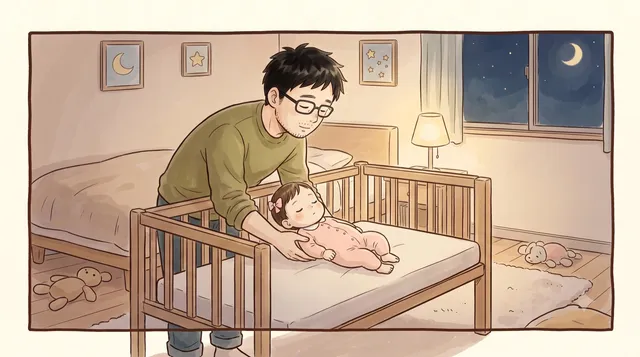
"Once asleep, move them to a firm, flat, bare infant surface, on the back" is an established recommendation backed by the AAP and Japan's Children and Families Agency. Don't keep them sleeping in a device. This part is public health, not anecdote.
So the principle never changes. Once they sleep in a device, move them to a flat surface as soon as you can. A car seat is necessary to protect against crashes on the road, and babies do fall asleep en route. The problem is at the destination. (How to build the safe surface is a separate post.)
One more thing. Walking, squats, and carriers all get more dangerous the sleepier you are. Rather than standing and swaying for tens of minutes at night, clear the floor, cap the time, and hand off. Sleepiness, unsteadiness, anger, being close to tears — those aren't a lack of effort, they're stopping criteria. Putting the baby down on their back in a safe space and resting for a few minutes is the safer move.
The Takeaway
The internet's staple bedtime hacks — squats, birth balls, driving — aren't so much ineffective as unchecked. And the bodily strain and crash risk are real. If you do them, keep them small, and reach for the lower-risk alternatives first.
But the thing to carry home isn't the methods — it's where they fell asleep. Wherever they drop off, move them to a flat surface once asleep. If you've hit your limit, put them down and step away instead of holding on.
Our birth ball, meanwhile, now rolls around in service of my abs. It is not being used.
More from Nijipapa's "Evidence-Based Parenting" series
- If Your Baby Cries the Second You Sit Down, Get Up and Walk
- It Never Said "Stop Co-Sleeping": Building a Safe Sleep Environment (A Serious One)
- "Calm" and "Asleep" Aren't the Same Thing: Splitting Bedtime Into Four Problems (bedtime series #1)
- Swaddling and White Noise Worked — But Each Has a Point Where You Stop (bedtime series #2)
- All My 3 a.m. Searching Left Me Was Anxiety: A Reading Order for Parenting Information
- Browse the full "Evidence-Based Parenting" series
Note: this post introduces published research and official resources; it is not a substitute for diagnosis or treatment. If you're unsure about bedtime posture or where the baby sleeps, please discuss it at a checkup or with your pediatrician.
Main sources: a case study of infant deaths in sitting devices in the US (Liaw et al., 2019); the AAP policy statement and technical report on safe sleep (2022 update); the WHO Guidelines on Physical Activity, Sedentary Behaviour and Sleep for children under 5 (2019); the Children and Families Agency's safe-infant-sleep guidance; and Japan's National Consumer Affairs Center advisories on baby-carrier accidents. For more, see the Children and Families Agency and the WHO.