Subtracting Beats Adding: What Actually Moves the Numbers on Safe Infant Sleep
I bought a pacifier.
I'd read that pacifier use at sleep time is associated with lower SIDS risk, so I bought one and felt like a responsible adult about it.
That same night, my daughter was sleeping on a thin towel I'd tucked under her head to catch spit-up, because it made the 3 a.m. changeover easier.
I thought I had added a layer of safety. Then I put the numbers side by side, and found I had the order backwards.
The protective numbers all stop at about half
One thing first: there are essentially no randomized trials here.
You cannot randomly assign babies to sleep prone, or to a smoking household, and count the deaths. So the evidence is built from case-control studies across many countries, death registries, and meta-analyses of those.
"No RCT" does not mean "no effect." But it also means you can't read an odds ratio from an observational study as a clean causal multiplier. That caveat follows us all the way down.
With that said, here are the headline numbers, mostly from a 2024 umbrella review covering 8 meta-analyses, 152 primary studies and 21 countries.
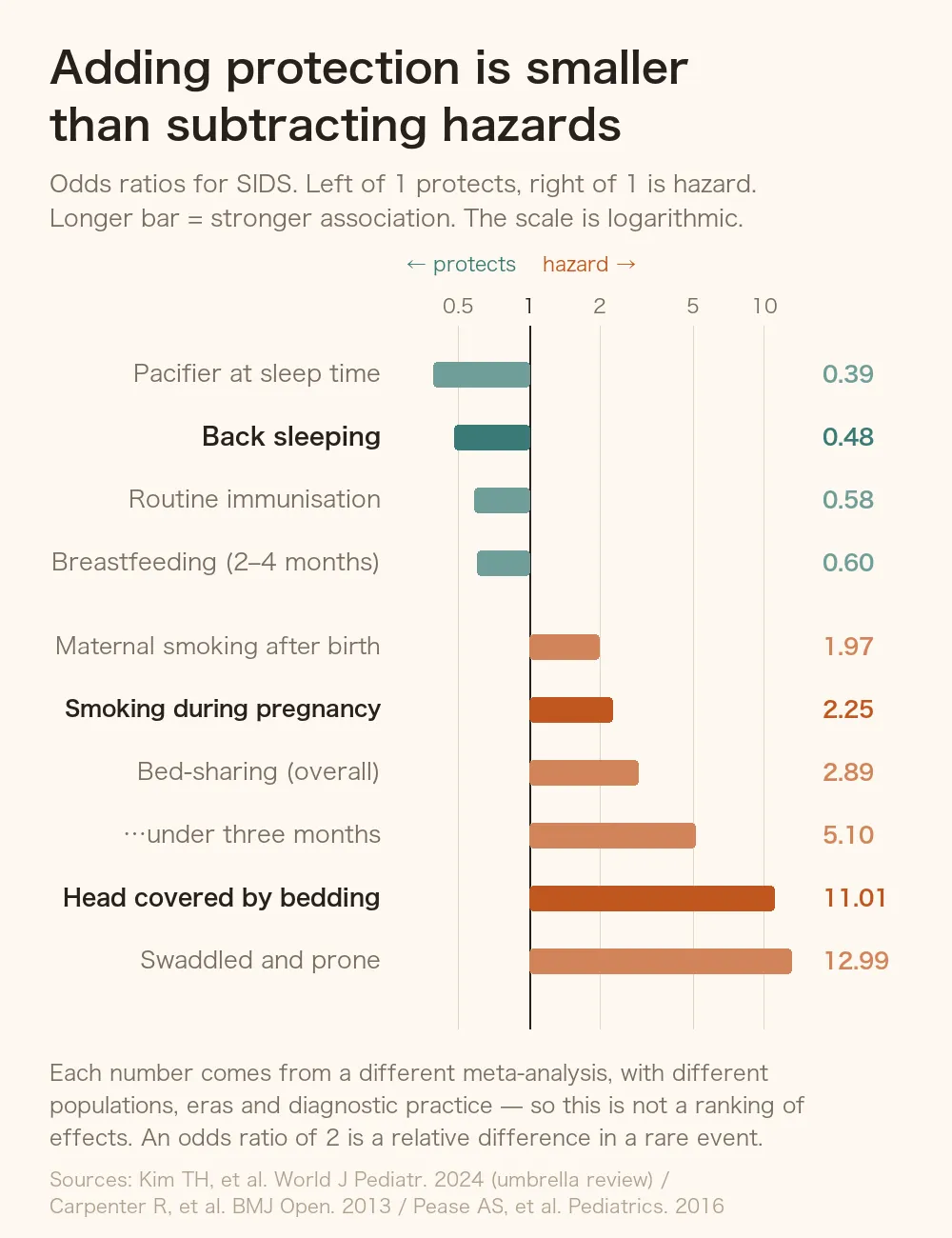
Look at the left side — the protective column.
- Back sleeping: 0.48
- Pacifier at sleep time: 0.39
- Breastfeeding at 2–4 months: 0.60
- Routine immunisation: 0.58
They cluster neatly between 0.4 and 0.6. Call it "roughly halves it." That is genuinely large — back sleeping in particular has the strongest evidence of anything here, including the natural experiment of SIDS rates falling after countries changed their advice in the 1990s.
But nothing on that side goes past about half. Stack all four and you don't get to a tenth.
And each one carries an asterisk.
Breastfeeding changes shape with duration. In an individual-participant analysis of 2,267 cases and 6,837 controls, under two months showed 0.91 — no clear protection — then 0.60 at 2–4 months, 0.40 at 4–6 months, and 0.36 beyond six months. It did not have to be exclusive; partial breastfeeding that continued still tracked with lower risk. But the 2024 umbrella review classified the pooled breastfeeding estimate as not meeting its reliability criteria — households that breastfeed also differ in smoking, healthcare access and sleep setup, and you can't cleanly separate the milk from everything around it.
Which means: treating "couldn't breastfeed" as a cause of SIDS is a misreading of this number. If you're formula feeding, the rest of this list is entirely available to you.
The pacifier 0.39 is also case-control. Cochrane found zero eligible randomized trials. And there's a plausible reverse-causation story: the night a baby skips a pacifier they normally use might be the night they were already unwell. It's recommended because the harms are small, not because the causality is settled.
有力単一の研究・限られた条件EMERGINGOne study · narrow conditions
The direction of all four protective factors is consistent across countries. The precise size — especially for breastfeeding and pacifiers — is not something observational data can pin down.
The biggest number wasn't anything I could buy
Now the right side. This one doesn't stop at half.
- Maternal smoking after birth: 1.97
- Smoking during pregnancy: 2.25
- Bed-sharing overall: 2.89
- Bed-sharing under three months: 5.10
- Head covered by bedding: 11.01
- Swaddled and prone: 12.99
The number that stopped me was 11.01.
Across ten population-based studies, the baby's head was covered at death in 24.6% of SIDS cases versus 3.2% of controls. That's one in four. Not a freak accident — the single most common picture.
Honestly, that 11 has a real weakness: you can't fully rule out that the baby moved the bedding during the terminal event, which would make the causality run backwards. So I won't write "eleven times more dangerous." What I'll write instead is the thing that survives either interpretation — don't put anything in the bed that can end up over a face.
And notice that this is not a purchase. It's a removal. Towels, muslins, blankets, quilts, cushions, soft toys, nursing pillows, cot bumpers. All of it just leaves. It costs nothing.
My spit-up towel came out that day.
Smoking has the same shape: 2.25 in pregnancy, 1.97 after, with a dose-response. "I don't smoke near the baby," "I open a window," "I smoke in the other room" don't eliminate what's left on clothing, skin and indoor surfaces. The move is a smoke-free home and car. Again: subtraction, not shopping.
Sleeping with a baby on a sofa or armchair is more dangerous than bed-sharing. In UK data, 17% of SIDS cases involved sofa co-sleeping versus 1% of controls. If you're feeding at night and about to fall asleep, the sofa is the worst possible place for that to happen — which is the finding I found most useful in practice, because it's the one I could actually picture.
Swaddling's 12.99 is specifically swaddled and prone (3.16 on the side, and still 1.93 supine). Only four studies, inconsistent definitions, low certainty. But the direction is clear enough: swaddling is not a SIDS prevention measure. If you use it — back only, nothing over the face or head, and stop the moment they try to roll. Weighted swaddles and weighted sleep sacks are not recommended.
Home breathing and oxygen monitors have no evidence of preventing SIDS. They are not a substitute for a safe sleep surface.
Bed-sharing is the one where countries disagree
This part deserves an honest answer rather than a tidy one.
The major guidelines do not agree on bed-sharing.
- AAP (US): can't identify conditions under which bed-sharing is safe, so doesn't recommend it. Recommends room-sharing on a separate surface.
- NICE (UK): starts from the fact that bed-sharing happens, explains how to make it safer, and then advises strongly against it where there's smoking, alcohol, drugs or sedating medication, or where the baby was preterm or low birth weight.
The studies disagree too. Pooling five large case-control datasets gave an adjusted odds ratio of 2.7 overall and 5.1 under three months. But a pooled analysis of two UK studies that stripped out the hazardous circumstances — smoking, alcohol, drugs, sofas, prematurity — put bed-sharing at 1.1 (1.6 under three months), not statistically significant.
How to read that?
Not as "bed-sharing has been proven safe once you remove the hazards." The case numbers were small, the hazards were self-reported, and confounding by feeding method and socioeconomic factors remains.
But equally, not as "2.89 times, uniformly, always." The fact that the number changes this much depending on circumstances is probably the actual finding.
So my conclusion is deliberately unsatisfying. If a separate infant sleep surface is available, room-sharing on a separate surface is the most consistently supported choice. And on top of that, avoiding bed-sharing matters most when there's smoking, alcohol or sedating medication in the picture, when the baby is under three months, and always on a sofa.
Room-sharing itself — as opposed to the baby sleeping in another room — also carries a protective association; AAP supports it for at least the first six months.
仮説仕組みからの推測HYPOTHESISInferred from mechanism
Extrapolating here. The gap between AAP's "avoid entirely" and NICE's "reduce the harm" looks to me less like a disagreement about evidence and more like a disagreement about communication. Blanket avoidance makes it harder for a parent who bed-shared unintentionally to say so — and if the alternative is falling asleep on a sofa instead, the safer conversation is about making the bed safer. I could not find a study that compares the two messaging strategies on actual deaths.
What not to do, and what to keep in mind
- Don't read an odds ratio as your household's probability. 2.89 does not mean "one in 2.89." These are relative differences in an event that is rare to begin with.
- Don't use these numbers to blame anyone. Breastfeeding and bed-sharing in particular are shaped by circumstances people don't fully control. The use for this post is emptying a cot, not assigning fault.
- Don't try to derive a "safe room temperature" from SIDS research. What matters isn't room temperature alone but the combination of total insulation from clothing and bedding, fever, head covering, prone position and ventilation. Check for sweating, a hot chest and flushing; skip hats indoors; prefer a correctly-sized, non-weighted sleep sack over anything loose.
- Know that the diagnosis itself moves. SIDS is a category meaning "we looked and could not find a cause." Where the line falls between SIDS, "unascertained" and accidental suffocation shifts by era and jurisdiction, so watching the SIDS rate alone will mislead you.
[My take] The removal did more than the purchase
What I took from this was an order of operations.
Adding protective layers isn't wrong. We still use the pacifier and we vaccinate on schedule. But those are layers you put on after the bed is empty — not instead.
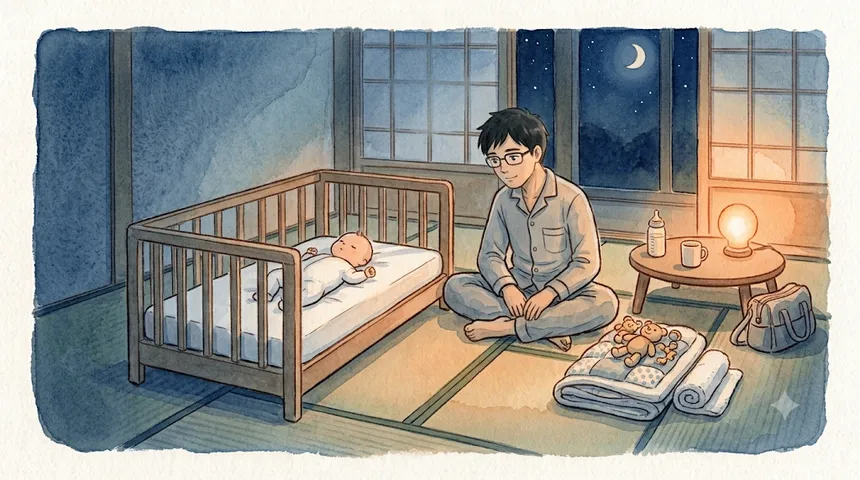
Take out the towel. Take out the soft toy. Swap the quilt for a sleep sack. Make the house and the car smoke-free. Then have the pacifier conversation.
For a few nights, I had that order exactly backwards.
The Takeaway
The numbers are asymmetric. Protection tops out around half; hazards run to two, five, eleven times.
So the first move isn't a purchase. It's emptying the bed.
The towel now lives on my pillow, next to the soft toy that got evicted last year. I don't know why either.
Related posts
- It Never Said "Stop Co-Sleeping": Building a Safe Sleep Environment (A Serious One)
- The Day I Closed the Parenting Book Without a Word: For Vaccine Schedules, Today's Official Source Is the Right One
- All My 3 a.m. Searching Left Me Was Anxiety: A Reading Order for Parenting Information
Note: this is a tour of the research and is no substitute for diagnosis or treatment. Sleep setups differ by housing and family situation — bring yours to a 健診 or your regular pediatrician.
Main sources: Kim TH, et al. Prenatal and postnatal factors associated with sudden infant death syndrome: an umbrella review of meta-analyses. World Journal of Pediatrics. 2024 / Gilbert R, et al. International Journal of Epidemiology. 2005 (sleep position) / Thompson JMD, et al. Pediatrics. 2017 (breastfeeding duration, IPD) / Hauck FR, et al. Pediatrics. 2005 (pacifiers) / Blair PS, et al. Archives of Disease in Childhood. 2008 (head covering) / Carpenter R, et al. BMJ Open. 2013 and Blair PS, et al. PLOS ONE. 2014 (bed-sharing) / Blair PS, et al. BMJ. 2009 (sofa co-sleeping) / Pease AS, et al. Pediatrics. 2016 (swaddling) / AAP 2022 safe sleep policy statement and technical report / NICE postnatal care guideline NG194. For guidance inside Japan, see こども家庭庁 and 厚生労働省.