The Day I Closed the Parenting Book Without a Word: For Vaccine Schedules, Trust Today's Official Sources
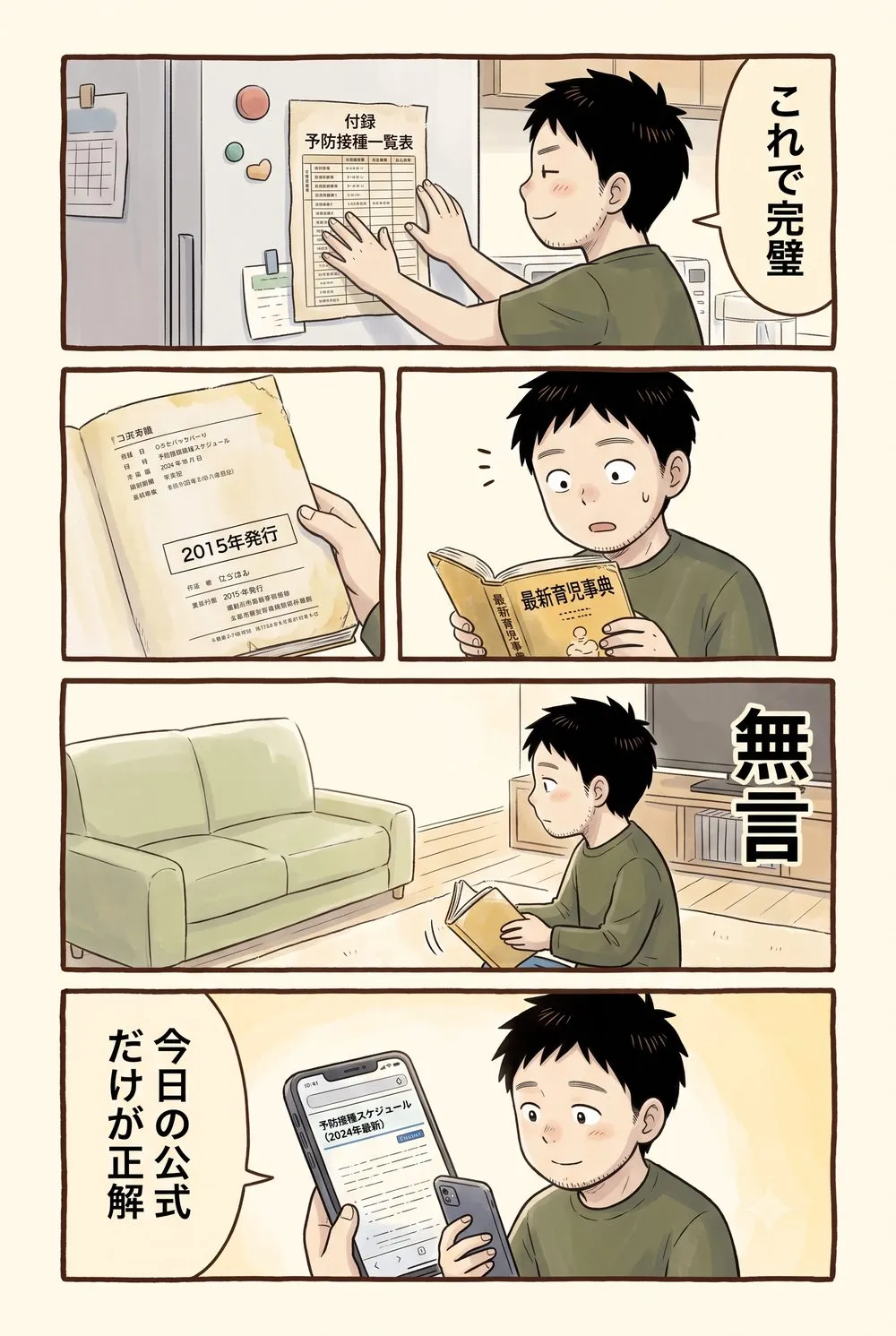
A parenting book I'd bought secondhand, for cheap, had a vaccination schedule chart in it.
Neatly color-coded, wonderfully easy to read. One glance told you exactly which shot happens when.
Feeling reassured, I snapped a photo and was about to stick it on the fridge — and then I checked the year on the copyright page.
...I closed the book without a word.
Why is a parenting book's vaccine chart dangerous?
Vaccination is, by a wide margin, the most policy-dependent territory in all of parenting. What's on the routine immunization list, when each shot is recommended, even how many vaccines get bundled into one combination shot — all of it gets rewritten within a few years.
So in this one area, the safest thing I could do was draw a hard line:
For the schedule, don't rely on books or blogs — go to the JIHS and MHLW pages as they stand today.
That includes this post. Don't trust it.
When does it start? Two months old is a fever dream of busy
The broad picture: starting at 2 months old, rotavirus, the 5-in-1 combination vaccine, pediatric pneumococcal, hepatitis B and others all begin at once, and BCG joins in from 5 months.
That "all at once" is the troublemaker.
With our first child, I missed the window for making the booking call, and the whole schedule slid back by a month. Nothing went wrong, exactly. I just never made the call.
So this time around, I took every item listed in the Maternal and Child Health Handbook (the boshi techo every parent in Japan carries) and loaded them all into the calendar in advance.
Are vaccines only about preventing disease?
This is the part that earned the biggest "huh!" of my reading.
In the American Academy of Pediatrics (AAP) materials summarizing risks of sleep-related infant death, routine immunization is listed as a "protective factor". In other words, vaccines are counted not merely as a defense against individual diseases, but as one part of a baby's overall safety.
One more thing. RSV prevention has been moving fast in recent years. A review by Cochrane (the international organization for systematic reviews) laid out evidence pointing toward RSV vaccination during pregnancy reducing RSV-related hospitalizations in the babies once they're born.
A shot given during pregnancy that protects the child after birth. That option simply didn't exist when our first was born.
For questions like this, I think the fastest route is to ask at a prenatal checkup.
So what, exactly, are parents supposed to do?
After all the reading, the to-do list came down to just three things.
- Check the latest schedule on the official sites (and just bookmark them)
- Book the 2-month round of shots right after the baby is born
- Write each vaccine into the Maternal and Child Health Handbook the day it's given
The handbook really earns its keep at times like this. The Children and Families Agency's information-support site also hosts a parent-facing PDF on immunizations — which ones there are, and when to get them.

にじパパTRANSMISSION
Says the guy who came within an inch of taping that chart to the fridge, I know — but for the schedule, and only the schedule, please look at today's official sources.
The Takeaway
When it comes to vaccinations, never trust old paper. Today's official source is the one that's right.
For the record, the old parenting book is still on our shelf. Its column on getting babies to sleep turned out to be surprisingly good.
More from Nijipapa's "Evidence-Based Parenting" series
- All My 3 a.m. Searching Left Me Was Anxiety: A Reading Order for Parenting Information
- It Never Said "Stop Co-Sleeping": Building a Safe Sleep Environment (A Serious One)
- No Honey, and Water at 70°C: Feeding a Baby Under One Has Surprisingly Few 'Absolutes'
- Browse the full "Evidence-Based Parenting" series
Immunization schedules change. Always check the latest official information before your visit. This article is no substitute for diagnosis or treatment.
Main sources: the immunization schedule from JIHS (Japan Institute for Health Security); immunization information from Japan's Ministry of Health, Labour and Welfare (MHLW); the Children and Families Agency's Maternal and Child Health Handbook information-support site; the AAP technical report on sleep-related infant deaths (2022); and the Cochrane systematic review on maternal RSV vaccination. For details, see MHLW and the Children and Families Agency.