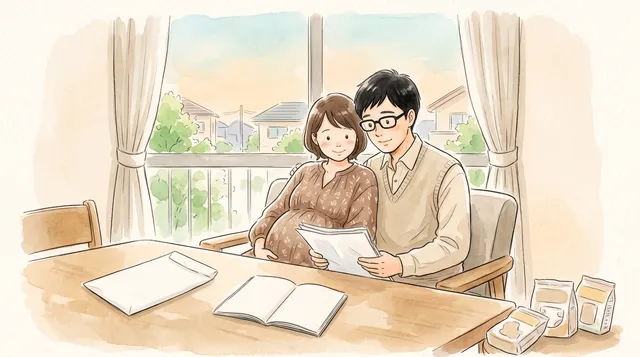
Only Two Pieces of Post-Birth Paperwork in Japan Are Genuinely Urgent. The Rest Can Wait Their Turn
The two weeks after a birth are the worst physical condition parents will be in all year.
The mother is in a body that has just given birth, the father is doing night duty for the first time, and neither of them has slept properly. If there is an older child, add a round of regression on top.
And that is exactly where the shortest deadline sits.
What's more, it isn't counted as "within two weeks" but as "within 14 days including the day of birth". That is a slightly mean piece of Japanese to parse on no sleep.
Only two things are actually urgent
Line up everything you're supposed to do after a birth and you get something like twenty items. And all twenty look like they weigh the same.
But the ones with a date fixed by law or by the program itself come to two, in practice.
Birth registration (shussei todoke) — within 14 days including the day of birth. This is set by the Family Register Act (Koseki Ho). Go to the family register counter at the city or ward office. Bring the birth certificate (shussei shomeisho) you get from the hospital and the Maternal and Child Health Handbook (boshi kenko techo). If the mother has gone back to her parents' home to give birth, you can also file it in the municipality where the baby was born, or in the parents' registered domicile (honsekichi).
Application for child allowance certification (jido teate nintei seikyu) — within 15 days from the day after the birth. This one is governed by a rule known as the "15-day exception" (15-nichi tokurei).
Both of these can be filed at the same office. Doing them together on the same day was the safest approach for us. Finish only one and file the other under "I'll get to it," and you get the accident described in the next section.
The child allowance is the one that never comes back
This is the single point in the whole post-birth process where a mistake cannot be undone.
The child allowance (jido teate) is, as a rule, paid starting from the month after the month you apply. The 15-day exception is the carve-out: if you apply within 15 days from the day after the birth, then even if the application itself slips into the following month, payment starts from the month of birth.
Flip that around and it means you cannot claim, after the fact, for a month where you missed that window.
For ages 0 to 2, the allowance is 15,000 yen a month. Fall a month behind and that amount simply disappears. As punishments for forgetting to hand in a form go, it's a fairly steep one.
On top of that, the income cap was abolished in October 2024. Whatever your income, if you file, you get paid. Assuming "we're probably over the income limit anyway" and not filing is, right now, the most wasteful pattern there is.
For families with an older child, there's one more effect. The count of which child is "first," "second" and so on for the child allowance includes older siblings up to the end of the fiscal year in which they turn 22. Simply having an older child can change how the younger one is treated.

にじパパTRANSMISSION
Back then I didn't understand why the office asked how old our older child was. That isn't small talk — it's a question that decides the amount.
Everything else is a guideline, not a deadline
The one-month checkup, the shrine visit (omiyamairi), the 3-to-4-month checkup, BCG. Most of the items on a post-birth to-do list belong in this category.
These are guideline timings, not things you fail by being a day late. Your municipality will send you notices, and you can still go even if the timing slips somewhat.
Carry all of it around as one undifferentiated "20 things to do after the birth" list, and everything ends up weighing the same — which buries the two items that actually matter.
So I sorted it like this.
- Deadlines: birth registration and child allowance (miss them and you lose something)
- Guidelines: checkups, the shrine visit, the first-meal ceremony (okuizome) and so on (let physical condition and the weather decide)
The shrine visit is traditionally held 31 to 33 days after birth, but in high summer or deep winter, it's fine to move it. The mother's recovery and the baby's condition come first.
Vaccinations alone sit somewhere in between: they start at 2 months old, and the first dose of the rotavirus vaccine has an upper age limit for safety reasons. I've split that out into the vaccine date calculator (the tool is in Japanese).
So you can stop counting days
In the end, everything in this post is date arithmetic.
And date arithmetic is exactly what a post-birth brain least wants to do. Nobody wants to work out "14 days including the day of birth" and "15 days from the day after" in their head, fresh out of the hospital.
So I made it into a page.
→ Post-Birth Paperwork Timeline (the tool is in Japanese)
Enter the baby's birthday once and it lays out the dates: the birth registration and child allowance deadlines, the checkups, the shrine visit, day 100, all the way to the 18-month checkup. Deadlines and guidelines are color-coded separately.
One thing I want to state plainly.
The birthday you enter is used for the calculation inside that screen only. It is not sent to a server. This site carries no analytics or measurement tags of any kind, so there is no mechanism here to collect it in the first place.
To be precise, there is exactly one thing it does save. So that you don't have to type it again next time, the birthday is remembered inside that browser and nowhere else. What it holds is a single date, with no name attached. Press the "保存を消す" (clear saved data) button on the page and it is gone on the spot. It never leaves your device.
Typing your baby's date of birth into some website, right after a birth, is a genuinely off-putting thing to do. I decided not to build the kind of thing I wouldn't want to type into myself.
The Takeaway
- The urgent items are just two: the birth registration at 14 days and the child allowance at 15 days. Same day, same office.
- With the child allowance, a late month never comes back. The income cap is gone, so just file it.
- Checkups and the shrine visit are guidelines. Let physical condition and the weather take priority.
- Details differ by municipality. Once the notices arrive, those are the authoritative version.
Primary sources consulted: Article 49 of the Family Register Act (Koseki Ho); the Children and Families Agency's "Guide to the Child Allowance System"; Article 12 of the Maternal and Child Health Act (Boshi Hoken Ho).