うちには、長らく謎の現象がありました。
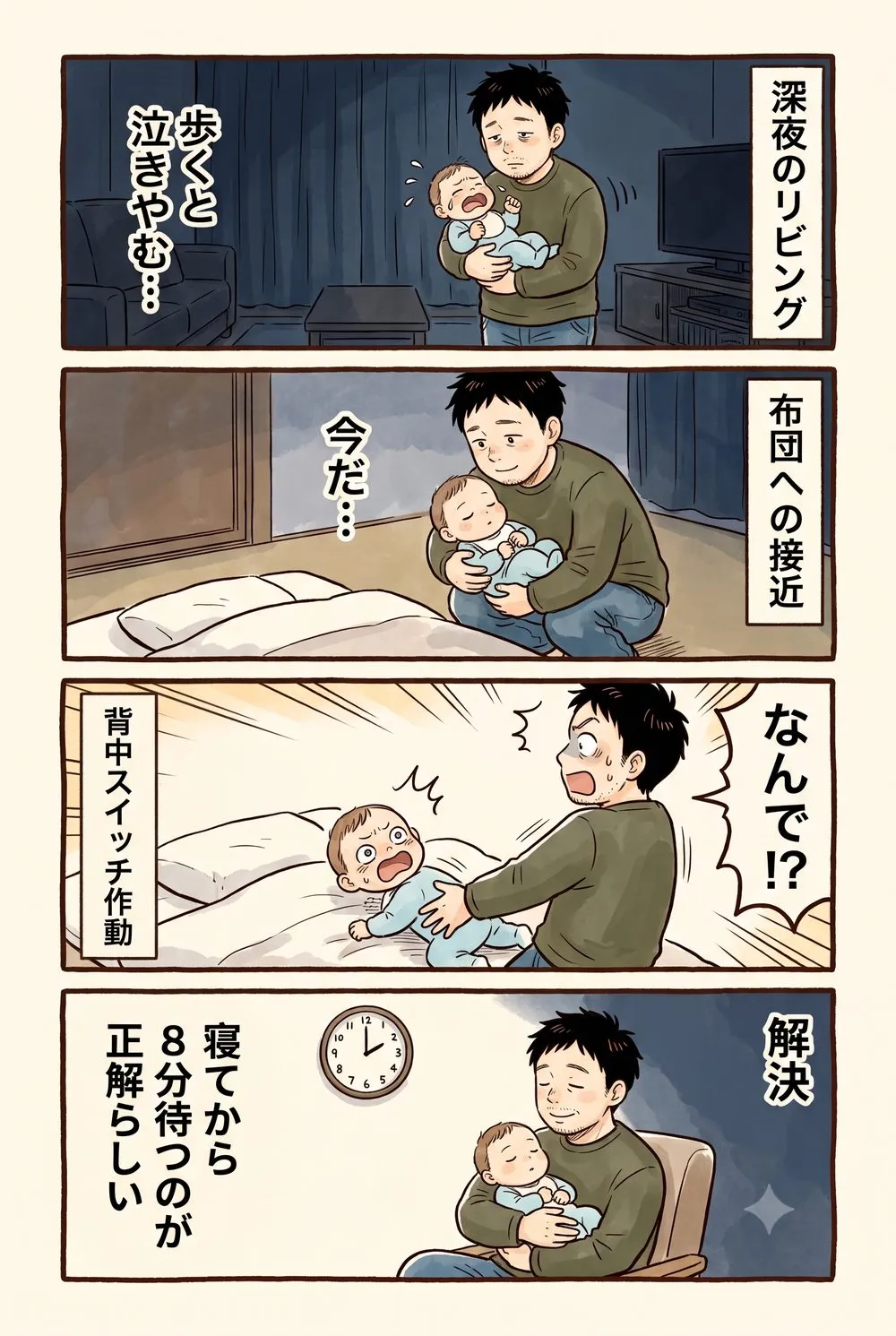
泣いている赤ちゃんを抱っこして歩くと、泣きやむ。そこはいい。問題は、疲れてソファに座った瞬間です。
泣きます。
同じ人間が、同じ強さで、同じように抱いているのにです。差分は「歩いているかどうか」だけ。
うちの子が厳しいのかと思っていました。違いました。これには「輸送反応」(英語でtransport response)という名前がついていて、日本の研究チームがきちんと調べていました。
目次
- 「輸送反応」とは何か
- なぜこんな仕組みがあるのか(以下、仮説です)
- 実践編:5分歩いて、5〜8分座る
- 背中スイッチは、背中になかった
- やってはいけないこと、知っておくこと
- 【僕の結論】「とりあえず歩く」は、正しかった
「輸送反応」とは何か
2013年、国際誌 Current Biology に、黒田公美さんらのチームが論文を出しています。
生後6カ月未満の赤ちゃんを、「ベッドに寝かせる」「座ったママが抱く」「ママが抱いて歩く」の3つで比べたところ、抱いて歩いたときだけ、赤ちゃんは泣きやみ、自発的な動きが止まり、心拍数まで下がりました。
座って抱いているだけでは、この反応は出ませんでした。うちのソファの件、論文に載っていました。
面白いのは、同じことがネズミの赤ちゃんでも起きることです。抱えて運ばれると、鳴きやんで、体をキュッと小さくする。つまりこれは、人間の赤ちゃんだけの話ではなく、哺乳類に広く共通する仕組みらしいということです。
なぜこんな仕組みがあるのか(以下、仮説です)
猫の子が首の後ろをくわえられると、ダランとして動かなくなるやつ。あれと同じ方向の話です。
親が子を抱えて移動するとき、子が暴れず静かにしていれば、親は楽に、早く、安全に運べる。研究者はこれを、赤ちゃん側からの**「運ばれることへの協力」**だと解釈しています。ねずみの実験では、この反応を邪魔すると、母親が子を回収するのに余計な手間がかかったそうです。
ここで、ちゃんと断っておきます。
「天敵から逃げるために黙る」という説明は、もっともらしくて楽しいし、研究の中でも議論されています。ただし、人間の赤ちゃんの脳が天敵を検知して黙っていると証明されたわけではありません。進化の仮説です。
正確に言うなら、「親に運ばれることをしやすくする、哺乳類が受け継いできた反応らしい」くらいがちょうどです。怖がって固まっているのではなく、協力してくれている。ここは、親として嬉しいところです。
実践編:5分歩いて、5〜8分座る
2022年、同じチームが「では、これを寝かしつけに使えないか」という研究を発表しました。泣いている赤ちゃんに対して、抱っこ歩行・座って抱く・ベビーベッドを動かす・寝かせるの4つを比べたものです。
- 抱っこして5分連続で歩くと、泣いていた赤ちゃんは全員泣きやんだ。うち約45%は、そのまま寝入った。
- 座って抱くだけでは、泣いている最中の子には効きにくい。動いていることが重要でした。
- 寝たあと、すぐに置かない。抱っこのまま座って5〜8分待ってから置くと、目を覚ましにくくなった。
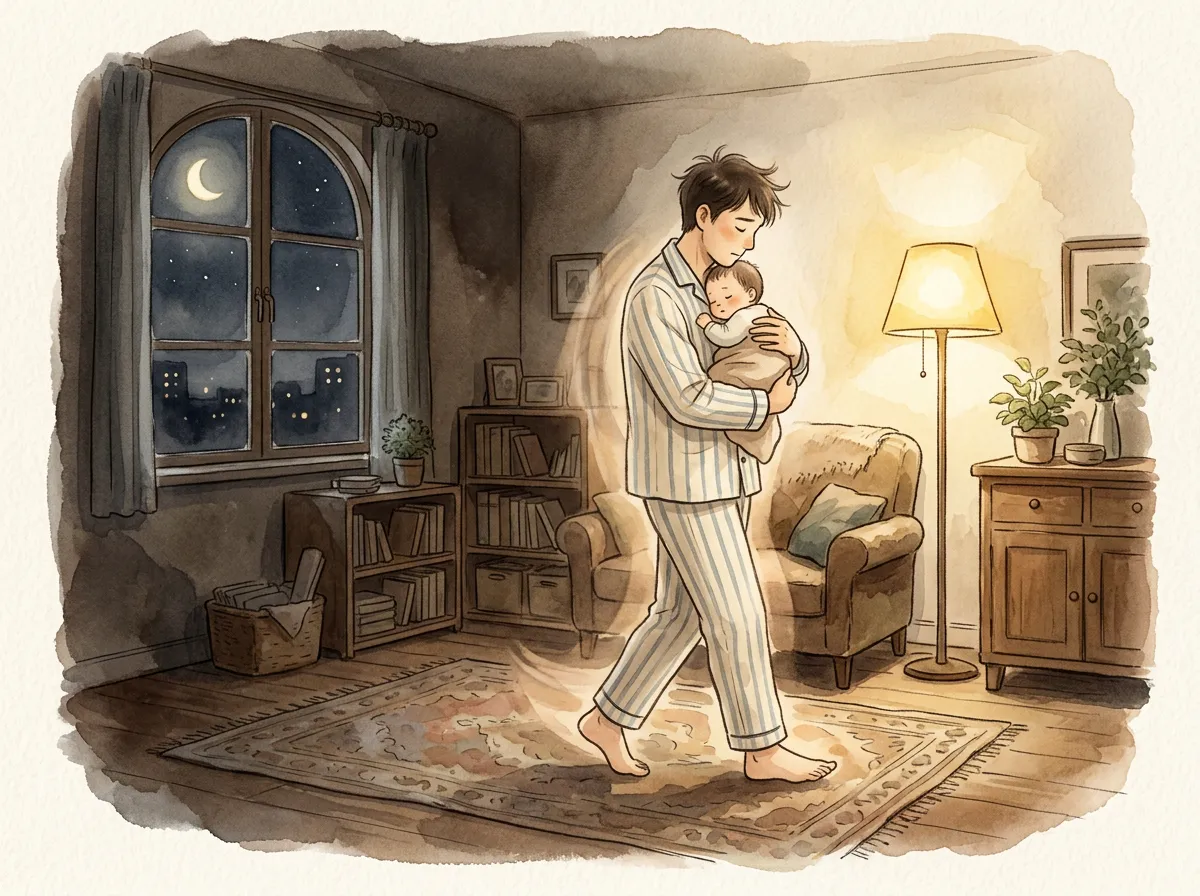
この5分は、途中で立ち止まらないのがコツだそうです。一定のペースで、とにかく歩く。リビングを周回する父の姿は間抜けですが、なにしろ論文に書いてあるとおりの行動です。胸を張って周回してください。
背中スイッチは、背中になかった
この研究で一番「そうだったのか」と思ったのがここです。
赤ちゃんが目を覚ますのは、背中が布団に触れた瞬間ではなく、親の体との密着が離れはじめたときだったということです。
つまり、そっと置こうと上半身を離しはじめた、そのときにもう勝負はついている。布団にセンサーがあるわけではなかったんです。
これを知ってから、置く直前の技巧を磨くのをやめました。磨くべきは、座ったまま待つ忍耐のほうでした。
やってはいけないこと、知っておくこと
- 走らない。検証されたのは普通の歩行です。速くすれば効くという話ではなく、転倒リスクも頭への揺れも増えます。落ち着いたペースで、しっかり支えて歩く。
- 寝たら、固く平らな寝床に仰向けで。抱っこは「泣きやませる手段」であって、寝かせておく場所ではありません。抱っこひもでの寝かしつけも、親が一緒に寝落ちするのは危険です。
- 5〜10分歩いても泣きやまないときは、体調を疑う。中耳炎など、どこかが痛いことがあります。研究チーム自身が受診をすすめています。
- この研究は小規模です。対象は7カ月未満の赤ちゃんと21組、しかもお母さんだけ。全員に効く魔法ではありません。
最後の点は大事なのでもう一度。これを試して寝なかったとしても、あなたの抱っこが下手なわけではありません。
【僕の結論】「とりあえず歩く」は、正しかった
深夜に、意味もわからず亡霊のように部屋を周回していた行為に、名前とエビデンスがつきました。
しかも、こちらがやさしくしているだけではなく、赤ちゃんのほうも「運ばれるモード」に入って協力してくれているらしい。共同作業だったと思うと、深夜の周回も少しだけ報われます。

つまり、深夜に亡霊のように部屋を周回していたのは、僕と赤ちゃんの共同作業だったわけです。
まとめ
5分歩いて、5〜8分座って、それから置く。背中スイッチの正体は、背中ではなく「離れはじめた瞬間」でした。
なお、この手順を覚えたつぎの夜は、周回中に自分が先に眠くなりました。人間にも輸送反応が残っているのかもしれません。
参考にした資料
- 赤ちゃんの泣きやみと寝かしつけの科学(理化学研究所プレスリリース、2022年)
- Infant calming responses during maternal carrying in humans and mice(Current Biology, 2013)
- 赤ちゃんの泣きやみと寝かしつけを科学する―背中スイッチではなかった―(日本生理学会)

にじパパ「寝かしつけ」関連記事
If Your Baby Cries the Second You Sit Down, Get Up and Walk
For a long time, our house had an unexplained phenomenon in it.
Pick up the crying baby, walk around, and the crying stops. So far, so good. The problem is the moment you get tired and sit down on the sofa.
Crying.
Same person, same grip, same arms. The only variable that changed was whether I was walking.
I assumed our kid was just a tough customer. Nope. This has a name — the transport response — and a Japanese research team has studied it properly.
Contents
- What the "transport response" actually is
- Why we'd be built this way (hypothesis territory from here)
- In practice: walk 5 minutes, then sit 5–8 minutes
- The back switch was never in the back
- What not to do, and what to keep in mind
- [My take] "When in doubt, walk" was right all along
What the "transport response" actually is
In 2013, a team led by Kuroda Kumi published a paper in the international journal Current Biology.
They compared babies under 6 months old across three conditions: lying in a bed, held by a seated mother, and carried by a walking mother. Only when they were carried while the mother walked did the babies stop crying, stop moving voluntarily, and — here's the part that got me — show a drop in heart rate.
Sitting and holding didn't produce the response. Our sofa situation, it turns out, is in the literature.
The fun part is that the same thing happens in mouse pups. Picked up and carried, they go quiet and pull their bodies in tight. So this isn't a human-baby quirk — it looks like a mechanism shared broadly across mammals.
Why we'd be built this way (hypothesis territory from here)
You know how a kitten goes limp and stops squirming when it's picked up by the scruff of the neck? Same general neighborhood.
When a parent picks a child up and moves, a child who isn't thrashing around is easier, faster and safer to carry. Researchers read this as the baby cooperating with being carried. In the mouse experiments, interfering with this response meant the mother had to spend extra effort retrieving her pups.
Now, a caveat, properly stated.
The "they go quiet so predators won't find them" explanation is tidy and fun, and it does come up in the research. But nobody has demonstrated that a human baby's brain is detecting predators and hushing up. It's an evolutionary hypothesis.
The accurate phrasing is closer to: this appears to be a response mammals have inherited that makes being carried by a parent go more smoothly. Not frozen in fear — helping out. As a parent, I find that a lovely thing to know.
In practice: walk 5 minutes, then sit 5–8 minutes
In 2022, the same team published the obvious follow-up study: can we actually use this to get babies to sleep? They compared four conditions with crying babies — being carried while the parent walks, being held by a seated parent, being moved in a cot, and simply being laid down.
- Carried while walking for 5 minutes straight, every crying baby stopped crying. About 45% of them fell asleep in the process.
- Just sitting and holding doesn't work well on a baby who is mid-cry. The movement was the essential ingredient.
- Once they're asleep, don't put them down right away. Sit down, keep holding them for 5–8 minutes, and then lay them down — they were less likely to wake up.
The trick with those five minutes, apparently, is not to stop partway. Steady pace, just keep walking. A dad doing laps of the living room is a ridiculous sight, but this is, quite literally, the behavior described in the paper. Lap with pride.
The back switch was never in the back
This is the finding that made me go "ohhh, so that's what's happening."
Babies wake up not at the moment their back touches the mattress, but at the moment the contact with the parent's body starts to come apart.
Which means that as you begin lifting your upper body away for that slow, delicate lowering, the match is already decided. There was never a sensor in the mattress.
Since learning this, I've stopped trying to perfect my put-down technique. The thing actually worth practicing was the patience to sit there and wait.
What not to do, and what to keep in mind
- Don't run. What was tested is ordinary walking. Going faster doesn't make it work better, and it increases both the risk of falling and the jostling to the baby's head. Calm pace, solid support.
- Once they're asleep, put them on their back on a firm, flat sleep surface. Carrying is a way to stop the crying, not a place to leave a baby sleeping. And settling a baby in a carrier is dangerous if the parent nods off too.
- If 5–10 minutes of walking doesn't stop the crying, suspect that something is wrong physically. Something may hurt — an ear infection, for example. The research team themselves recommend getting the baby seen.
- This is a small study. It covered 21 pairs with babies under 7 months old — and mothers only. It is not a spell that works on every baby.
That last point matters enough to say twice: if you try this and your baby doesn't sleep, it doesn't mean you're bad at holding your baby.
[My take] "When in doubt, walk" was right all along
The thing I'd been doing in the middle of the night — drifting around the room like a ghost with no idea why — now has a name and evidence attached to it.
And it isn't only me being gentle with them. The baby, apparently, is switching into "being carried" mode and meeting me halfway. Thinking of it as teamwork makes the midnight laps feel a little more worthwhile.

So all that ghostly midnight circling of the living room? It was a joint project between me and the baby.
In summary
Walk for 5 minutes, sit for 5–8 minutes, then put them down. The true identity of the "back switch" isn't the back — it's the moment you start to pull away.
Also worth noting: the night after I learned this sequence, I was the one who got sleepy first, mid-lap. Maybe the transport response survives into adulthood.
Sources
- The science of calming babies and settling them to sleep (RIKEN press release, 2022, in Japanese)
- Infant calming responses during maternal carrying in humans and mice (Current Biology, 2013)
- The science of calming babies and settling them to sleep — it wasn't the back switch (The Physiological Society of Japan, in Japanese)