Your Kid Will Answer You in Japanese. It Isn't Because You Failed
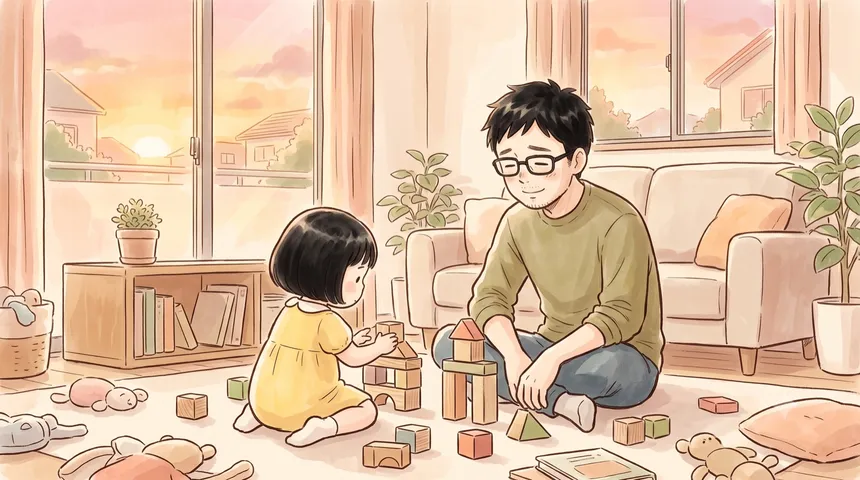
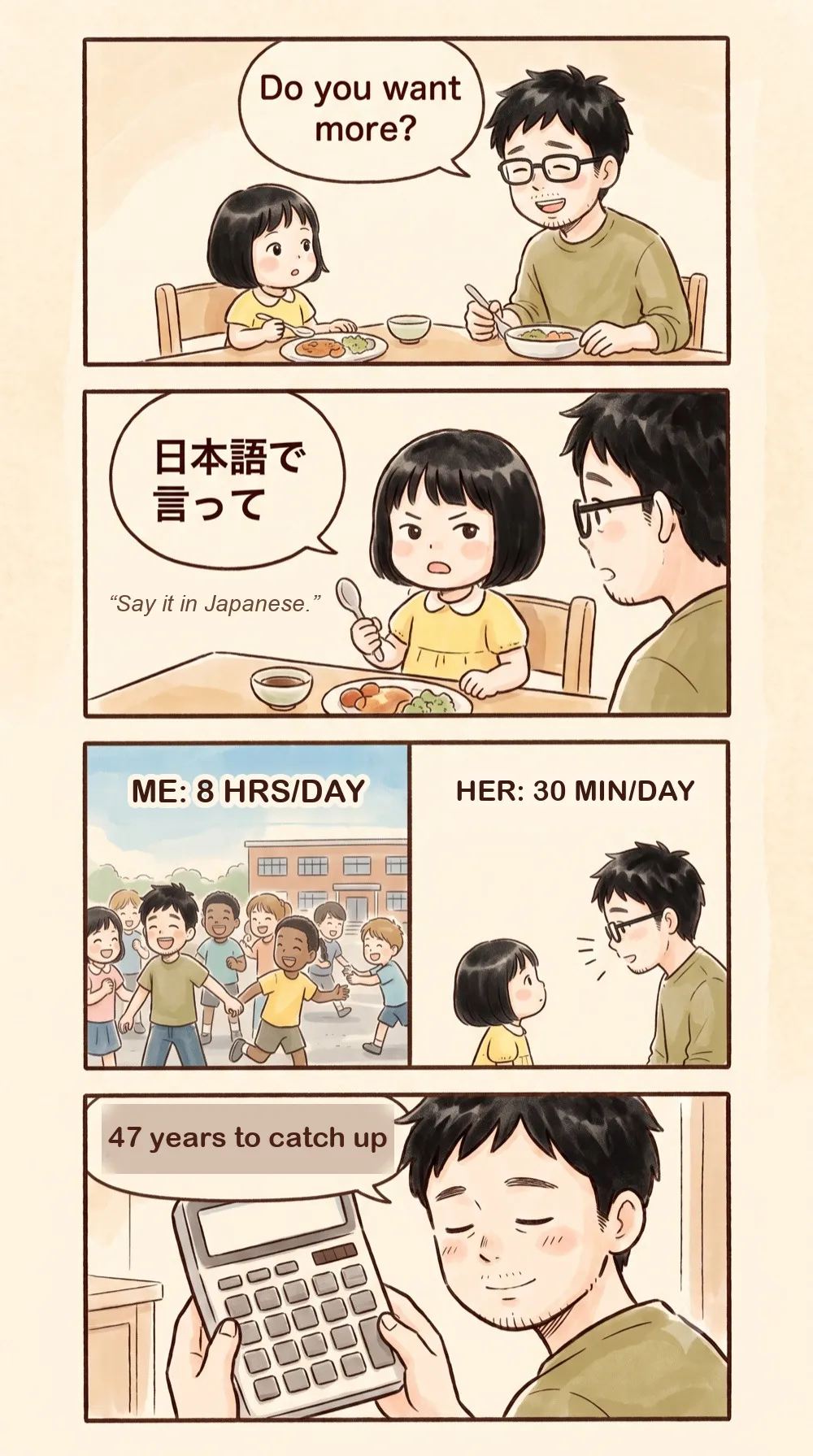
If you're raising a child in Japan in a language that isn't Japanese, you already know the moment. You say something in your language. Your child answers in Japanese. Eventually they stop pretending to humour you and just say it: say it in Japanese.
I got that from my three-year-old at the dinner table in Nagoya. In my case the language was English — and I'm the guy who is supposed to be good at this. I grew up in the United States. I'm a Japanese–English bilingual. I have scored 990 on the TOEIC twice.
None of that helped, and for a while I assumed the problem was me: not consistent enough, not patient enough, not natural enough.
Then I counted the hours from my own childhood, and the whole thing looked different.
What actually made me bilingual
My childhood was the mirror image of my daughter's.
English came from outside the house: six or seven hours of school, and eight to ten hours a day once you count the friends I walked home with. Japanese came from inside it — my parents spoke it, and on Saturdays I went to Japanese school to keep it from slipping. I stayed in the United States through university and a master's degree, until I was 24.
The important part is what I didn't have: a veto. If I didn't understand English, I didn't understand the lesson. If I couldn't produce English, I didn't have friends. A three-year-old's "say it in Japanese" simply wasn't available to me as a move.
My father did not make me bilingual. The structure did. And the minority language in that house — Japanese — still needed two parents and a weekend school holding it up.
That's what your own effort is quietly being measured against.
The arithmetic in your house
If you live in Japan, your child's day looks roughly like this: hoikuen or youchien in Japanese, neighbours in Japanese, television in Japanese, the doctor in Japanese, the entire street in Japanese — and your language arrives from one adult, part-time, in the gaps.
Mine is at hoikuen all day. At home my wife speaks Japanese, and I start sentences in English and finish them in Japanese without noticing. Generously counted, she gets thirty minutes a day from me.
So I did the arithmetic. Six years of elementary school alone — eight hours a day, 180 days a year — came to roughly 8,600 hours of English. I stopped counting there; secondary school, university and grad school aren't in that figure.
Thirty minutes a day, every single day, comes to about 180 hours a year.
8,600 ÷ 180 is 47 years.
At her current dose, my daughter reaches my eleven-year-old self's English somewhere around her fiftieth birthday. That imbalance is not a detail. It's the whole result.
Hoff and colleagues (2012) followed 47 Spanish–English bilingual children between 1;10 and 2;6, alongside 56 monolinguals. Within the bilingual group, every measure of vocabulary and grammar tracked the relative amount of input in that language.
(There's good news buried in the same study, and it's worth saying to whoever in your family is worried: the bilingual children looked behind in each language separately, but their total vocabulary was comparable to monolinguals. Two languages didn't cost them words. It just spread them out.)
Then there's the question of parenting strategy. De Houwer (2007) surveyed 1,899 families in Dutch-speaking Flanders in which at least one parent spoke a language other than the community language, with children aged 6 to 10. Every child spoke Dutch. Not every child spoke the other one.
Her Table 7 breaks it down by who spoke what at home:
| How the languages were distributed at home | Families with a child who spoke the minority language |
|---|---|
| Both parents, minority language only | 96.9% (409 of 422) |
| One parent minority only; the other minority + Dutch | 93.4% (227 of 243) |
| Both parents, minority language + Dutch | 79.2% |
| One parent minority only; the other Dutch only (OPOL) | 74.2% (147 of 198) |
| One parent minority + Dutch; the other Dutch only | 35.7% (126 of 353) |
De Houwer's conclusion: one parent, one language is neither a necessary nor a sufficient condition.
Two things to keep straight about these numbers. They are not fluency rates — they count families where at least one child was reported to speak the minority language at home. And this is observational: the patterns travel together, but the study doesn't prove the strategy caused the outcome.
With that said, look at the bottom row. If you are the only source of your language and you also speak Japanese with your child, that is where you are — 35.7%. Not because you did it wrong. Because of how the hours divide.
Understanding is cheaper than speaking
Here's the finding that changed what I aim for.
Thordardottir (2011) tested five-year-olds in Montreal across the full range of French–English exposure, from almost none to almost all. Exposure and vocabulary were strongly related — but the shape of that relationship differed for comprehension and production.
Children exposed to both languages equally scored comparably to monolingual children in receptive vocabulary, but greater exposure was required to match monolingual standards in expressive vocabulary.
Read that twice if you're tired. Understanding arrives on less fuel than speaking does.
Your child probably isn't getting the input volume that production requires. Aiming at it anyway isn't ambition; it's a fuel calculation error. But comprehension — a six-year-old who follows you completely, even while answering in Japanese — is genuinely inside the range that one committed parent can reach.
仮説仕組みからの推測HYPOTHESISInferred from mechanism
Extrapolating here. Thordardottir studied five-year-olds in Montreal, and French and English are close relatives. Japanese and English are not, and a household in Japan is not a household in Quebec. I believe the direction — comprehension is cheaper — but this study can't tell you the exact dose for your language pair.
What not to do, and what to keep in mind
- Don't turn the language of the reply into a discipline issue. Making them repeat it in your language doesn't add input. It adds tension, and tension is the one thing that reliably reduces future input.
- Know the limits of these numbers. De Houwer's data are parent questionnaires from Dutch-speaking Belgium about 6-to-10-year-olds — self-reported, observational, and measuring "speaks it" rather than "speaks it well." Thordardottir's are Montreal five-year-olds in two closely related languages. Neither was collected in Japan.
- If you're worried about language development itself, that's a different question. Bring it to a 健診 or your pediatrician. This post is about exposure volume, not assessment.
[My take] I lowered the target — and I'm telling you what I still want
My goal for my daughter moved from "speaks English" to "understands English," for the reasons above.
But I'll be honest, because a post like this is worthless if I'm not.
I still want her to speak it.
On the days she produces something in English, I'm quietly delighted. I write "understanding is enough" and some part of me keeps waiting for production anyway.
I think those two things can coexist. Lower the target; keep the hope. Just don't hand either one to your child as a debt — and don't take it on as guilt yourself. Once you know it was arithmetic, you don't have to.
The Takeaway
My daughter refused my language because of hours, not because of effort — mine or hers.
You can't out-parent a structure. But you can choose what you're aiming at.
For what it's worth, I haven't stopped speaking English to her. She still answers in Japanese. I've decided that's fine.
Sources
- De Houwer, A. (2007). Parental language input patterns and children's bilingual use. Applied Psycholinguistics, 28(3), 411–424.
- Thordardottir, E. (2011). The relationship between bilingual exposure and vocabulary development. International Journal of Bilingualism, 15(4), 426–445.
- Hoff, E., Core, C., Place, S., Rumiche, R., Señor, M., & Parra, M. (2012). Dual language exposure and early bilingual development. Journal of Child Language, 39(1), 1–27.