Why Talk to Someone Who Can't Talk Back? The Answer From 102 Trials
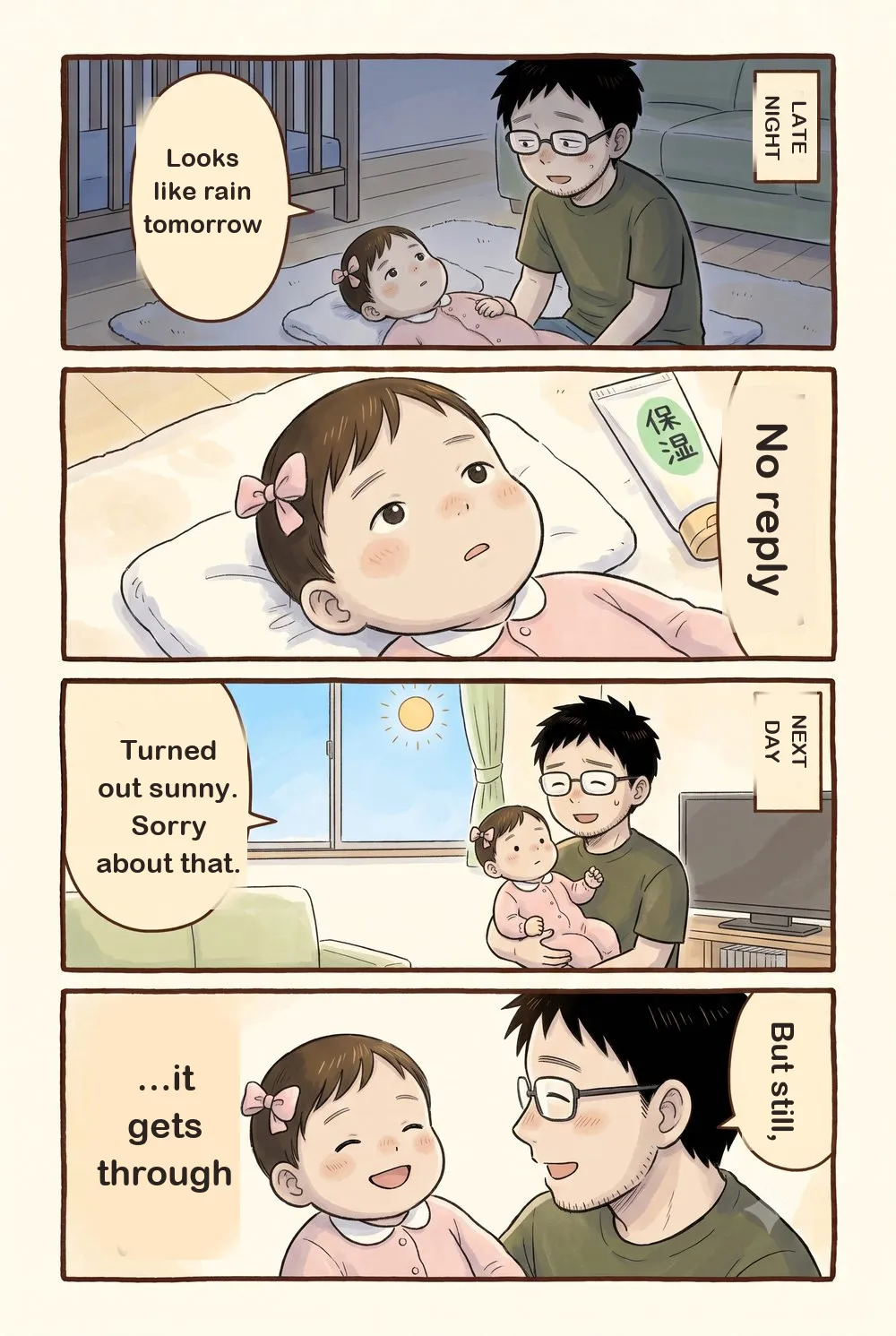
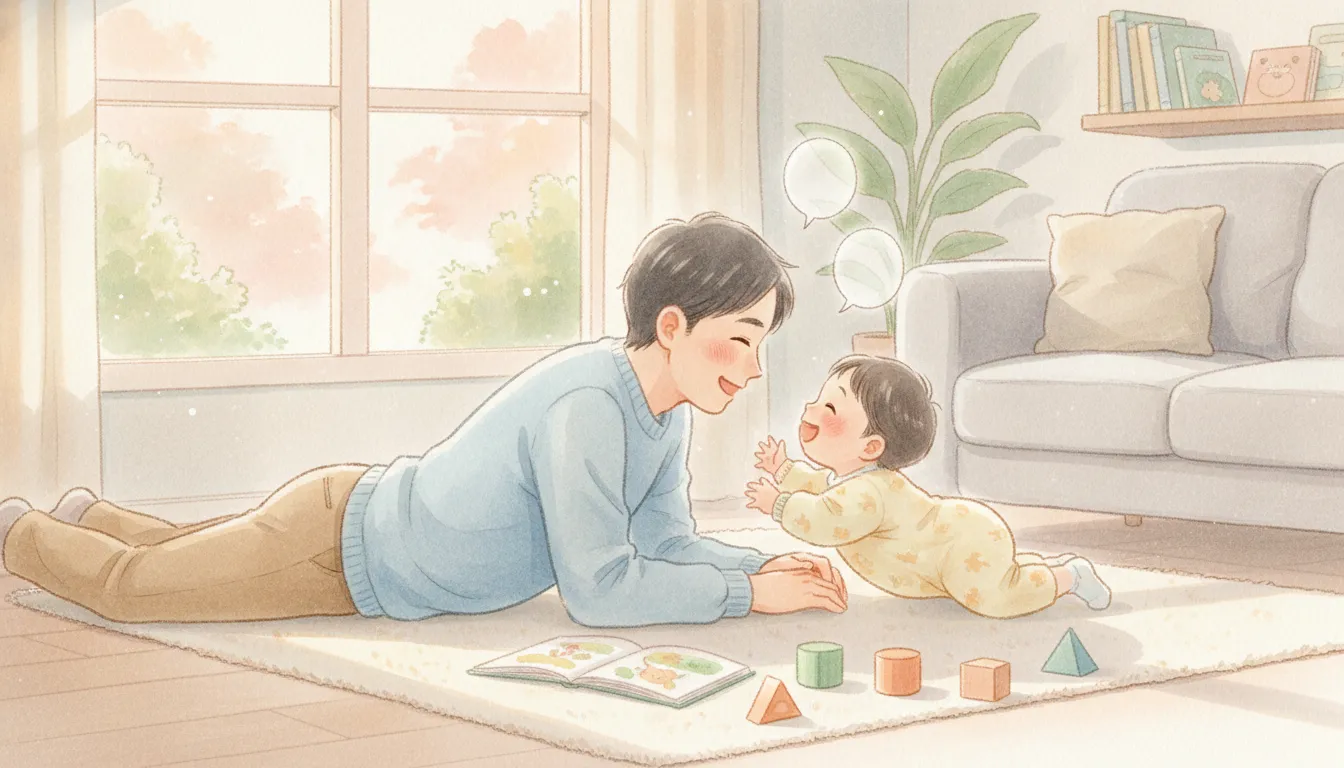
Late one night in the living room, I was briefing my baby on the weather forecast.

にじパパTRANSMISSION
Rain tomorrow, they say. Hmm. What are we going to do about the laundry...
My audience was staring at the ceiling. Wouldn't even make eye contact.
And in that moment the thought crept in: is there any point to this?
Let me skip straight to the conclusion. Yes. There is. Not as a feel-good platitude — at the level of actual research.
How much evidence is there behind "talking to your baby"?
A meta-analysis published in PLOS Medicine in 2021 turned out to be seriously convincing.
Pooling 102 randomized controlled trials (RCTs) from 33 countries, it found that parenting interventions improved children's cognitive, language, motor, and social-emotional development, attachment, and behavior. At the same time, they improved parents' knowledge, parenting practices, and parent–child interaction.
In other words: talking to your baby, responding to them, playing together — that whole family of things pretty much works.
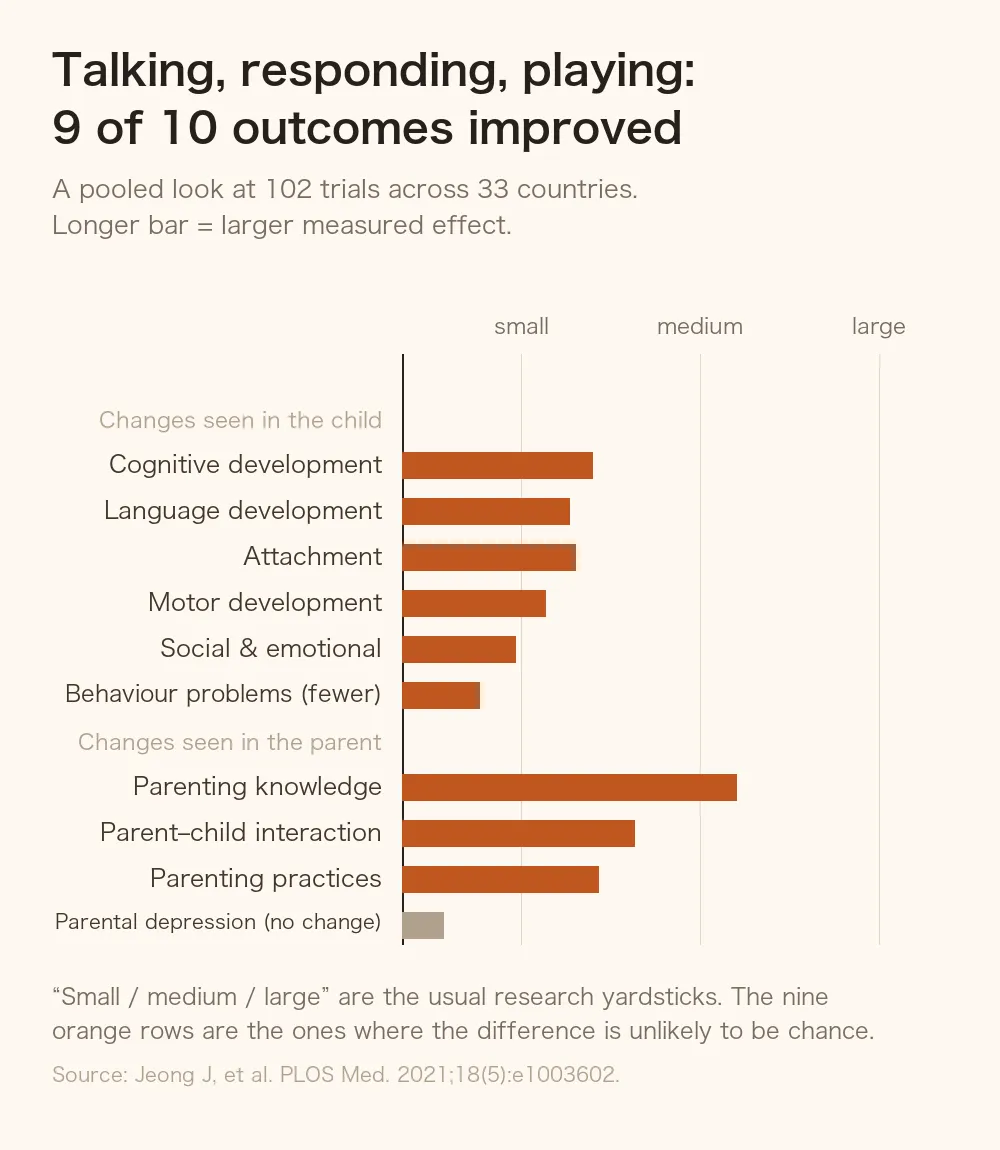
For what it's worth, the direct effect on parents' depressive symptoms was inconsistent. The paper says so, straight out — which, if anything, made me trust it more.
What does the WHO recommend for early development?
In its 2020 guideline, the WHO positions responsive caregiving and early learning as core interventions in infancy and early childhood.
Responsive caregiving is nothing complicated. It means responding, in the moment, to the signals your baby sends. They make a sound, you answer. They stare at something, you look at it together.
One more thing that matters here: the WHO also recommends integrating nutrition support with development support, and integrating mental health support for mothers.
In other words, feeding, sleep, development, and a parent's state of mind are not separate conversations. Of everything I've written in this series, this is where the threads finally connected for me.
If you're worried about development, where do you take it?
This is one area where I think Japan is genuinely strong.
Japan's Children and Families Agency runs legally mandated well-child checkups at 18 months and 3 years, and on top of that it is building out systems for checkups at 1 month, 3–6 months, and 9–11 months.
So rather than digging through the papers all by yourself, this order turned out to be the realistic one:
- Bring up whatever you've noticed at the checkup
- Look at guidelines or reviews if you need to
- Talk it over with your family pediatrician
One more thing. Large-scale research from JECS (the Japan Environment and Children's Study) has mapped difficulties with mother-infant bonding on a national scale. Which means "I can't feel the affection I'm supposed to feel" is not some rare personal defect — it's an established subject of research.
That was a fact I was glad to have. Reaching out when you're struggling isn't self-indulgence.
Wrapping up
Even with no reply, talking to your baby meant something. And apparently, it works on the parent too.
For the record: the next day was sunny. I apologized to the baby.
More from Nijipapa's "Evidence-Based Parenting" series
- All My 3 a.m. Searching Left Me Was Anxiety: A Reading Order for Parenting Information
- It Never Said "Stop Co-Sleeping": Building a Safe Sleep Environment (A Serious One)
- “Moisturize and They Won’t Get Allergies” Turned Out to Be Too Simple: Eczema and Food Allergies
- Browse the full "Evidence-Based Parenting" series
Note: this post is an overview of published research and official materials, and is no substitute for diagnosis or treatment. If you're worried about your child's development, raise it at a checkup or with your family pediatrician. And if the strain of parenting or a low mood just won't lift, reach out to your municipal children-and-families support center or public health center.
Main sources: WHO, Improving Early Childhood Development guideline (2020); meta-analysis of parenting interventions (PLOS Medicine, 2021; 102 RCTs across 33 countries); Japan's Children and Families Agency initiatives on infant and toddler health checkups; JECS (the Japan Environment and Children's Study) research on mother-infant bonding. For more, see the WHO and the Children and Families Agency.