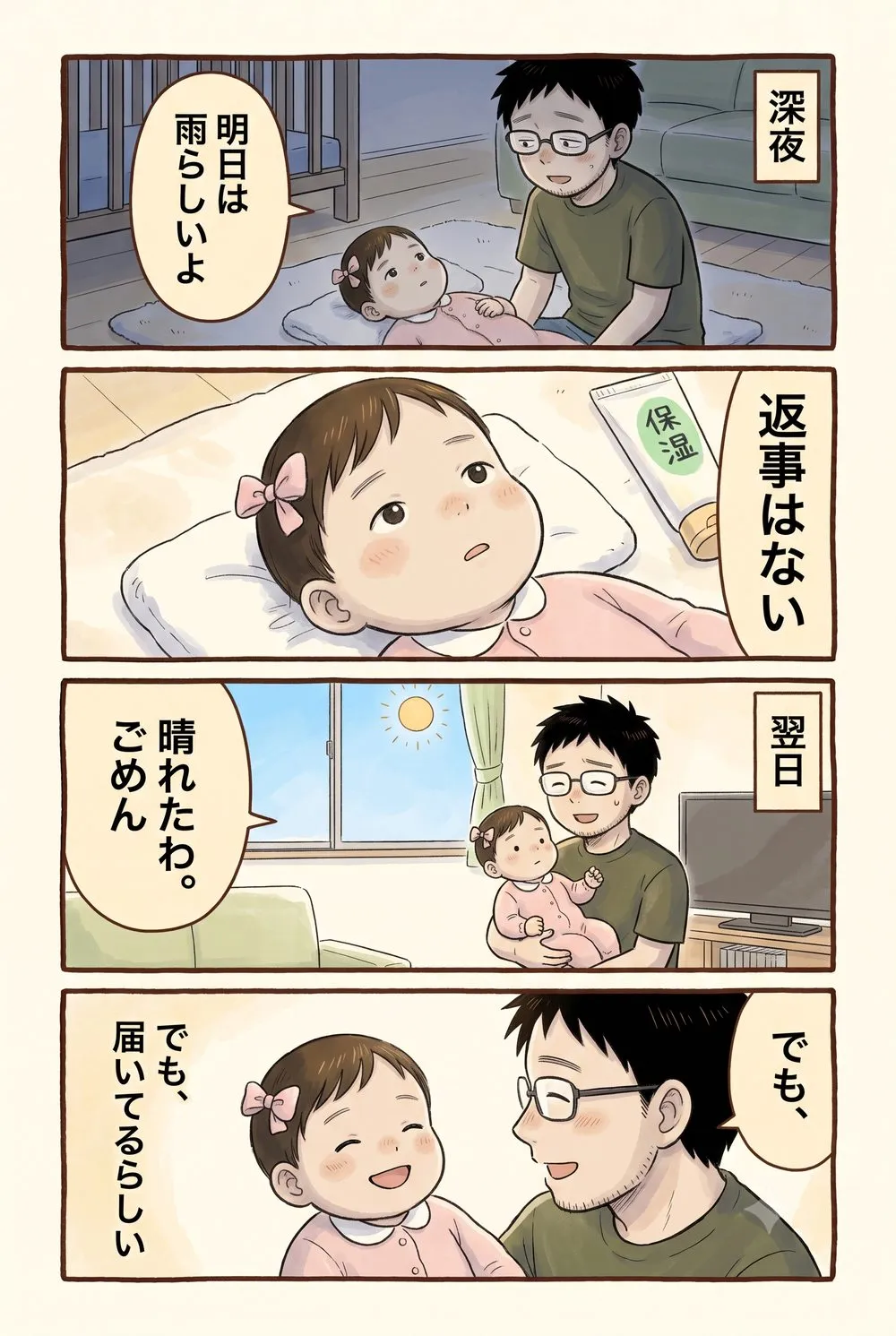
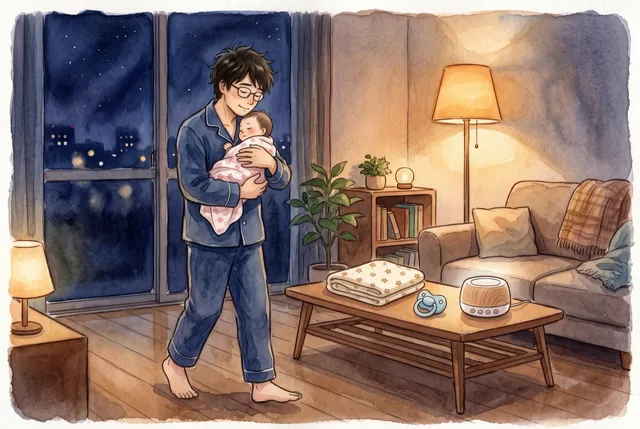
深夜のリビングで、赤ちゃんに向かって天気の話をしていました。

にじパパのアバター
にじパパ
ひとこと

明日は雨らしいよ。洗濯物、どうしようかなあ。

相手は天井を見ています。目も合わない。

その瞬間、ふと思ったんです。これ、意味あるのかな。

結論を先に言います。**意味、ありました。**気休めではなく、研究のレベルで。

4コマ4コマ漫画。深夜、返事のない赤ちゃんに天気の話をする父。翌日晴れて謝ると、赤ちゃんが笑った。
4コマ:返事はなくても、届いている

目次

  1. 「話しかける」には、どのくらい根拠があるのか?
  2. WHOは、発達のために何を推奨しているのか?
  3. 発達が気になるとき、どこに持っていけばいいのか?

「話しかける」には、どのくらい根拠があるのか?

2021年にPLOS Medicineに出たメタ解析が、かなり強力でした。

33か国、102件のランダム化比較試験(RCT)をまとめたところ、親向けの介入は、子どもの認知、言語、運動、社会情緒、愛着、行動面に改善をもたらしていました。同時に、親の知識、実践、親子のやりとりも改善していました。

つまり、語りかける・応える・一緒に遊ぶといった関わり方は、だいたい意味があると。
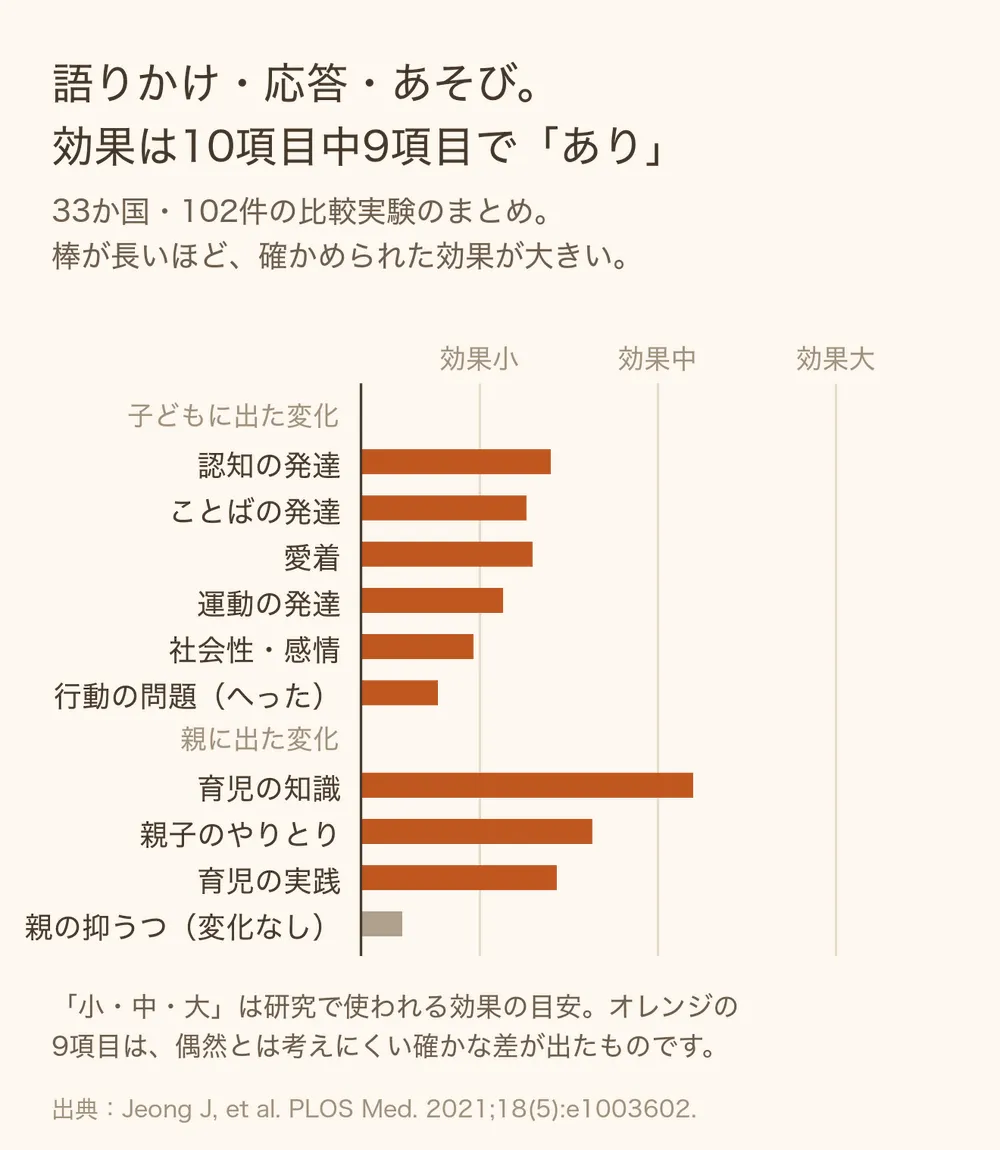
語りかけ・応答・あそびの効果を10項目の棒グラフで示した図。子どもの認知・ことば・愛着など9項目で効果あり、親の抑うつのみ変化なし。効果の大きさはおおむね小から中
一番下を除いて、全項目で「効果あり」。一番大きかったのは、親の側の変化でした。

ちなみに、親の抑うつ症状への直接の効果は一貫しなかったそうです。そこは正直に書いてあるのが、むしろ信用できると思いました。
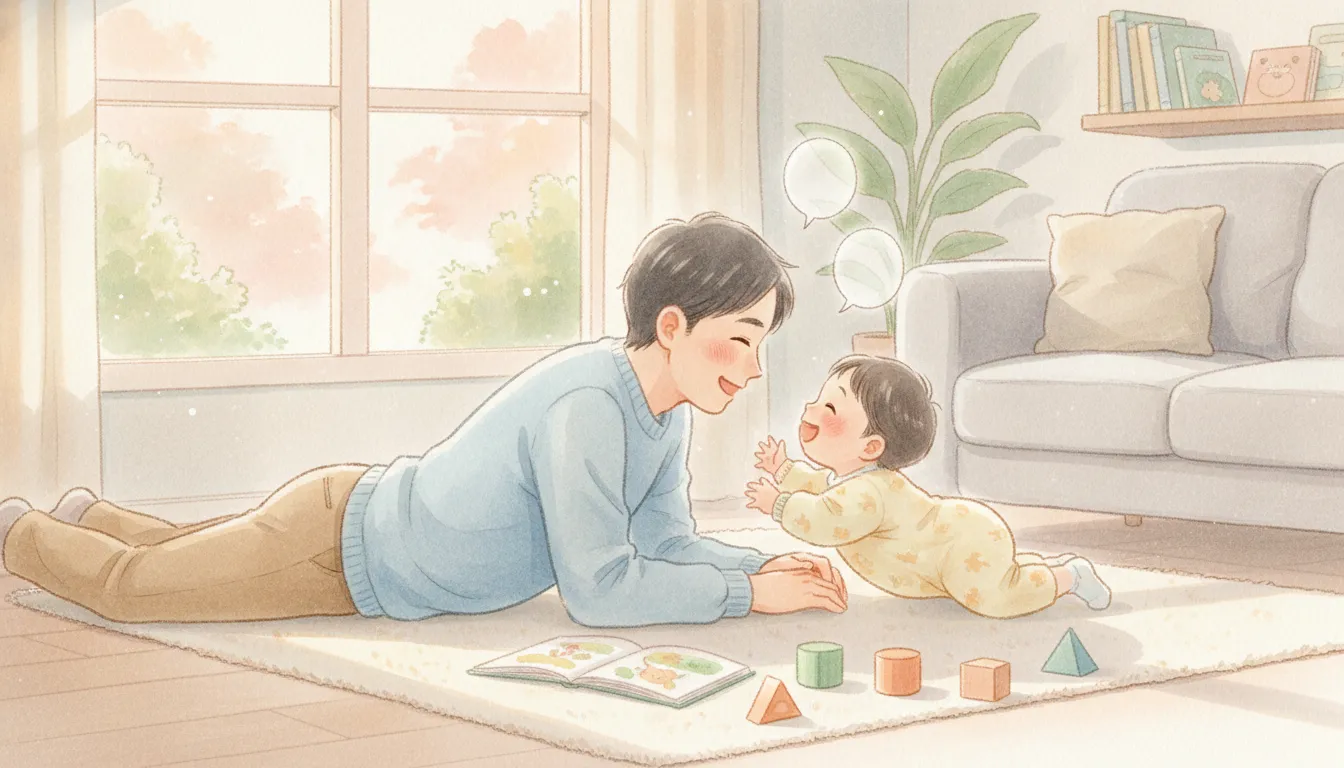
床にうつ伏せで赤ちゃんと顔を見合わせて語りかける父親。まわりに絵本と積み木(水彩イラスト)
この体勢は腿がしびれます。10分が限界でした。

WHOは、発達のために何を推奨しているのか?

WHOの2020年のガイドラインでは、応答的な養育(responsive caregiving)と早期の学びが、乳幼児期の中核的な介入として位置づけられています。

応答的な養育というのは、難しいことではなく、赤ちゃんが出したサインに、その場で応えるということです。声を出したら返す。見ていたものを一緒に見る。

もうひとつ大事なのが、WHOが栄養支援と発達支援の統合、そして母親のメンタルヘルス支援の統合も推奨しているところです。

つまり、食事と睡眠と発達と親のこころは、別々の話でない。このシリーズを書いていて、一番脈絡がつながったのがここでした。


発達が気になるとき、どこに持っていけばいいのか?

ここは日本が強いところだと思います。

こども家庭庁は、1歳6か月児・3歳児健診を法定で実施し、加えて1か月、3〜6か月、9〜11か月の健診などの体制整備も進めています。

だから、論文をひとりで読み込むより、この順番が現実的でした。

  • 健診で気づいたことを話す
  • 必要に応じてガイドラインやレビューを見る
  • かかりつけに相談する

もうひとつ。JECS(子どもの健康と環境に関する全国調査)の大規模研究では、母子ボンディングの困難が全国規模で把握されています。「かわいいと思えない」は、珍しい欠陥ではなく、研究の対象になっているということです。

これは、知っておいて良かったと思った事実でした。しんどいときに相談するのは、甘えではないと。

まとめ

返事がなくても、話しかけることには意味があった。そしてそれは、親のほうにも効いているらしい。

なお、翌日の天気は晴れでした。赤ちゃんに謝りました。

にじパパ「エビデンス育児」関連記事

※この記事は論文・公的資料の紹介で、診断や治療の代わりにはなりません。発達の心配は健診やかかりつけの小児科へ。また、子育てのしんどさや気分の落ち込みが続くときは、自治体のこども家庭センターや保健センターへ相談を。
主な出典:WHO Improving Early Childhood Development ガイドライン(2020)/親向け介入に関するメタ解析(PLOS Medicine、2021、33か国102件のRCT)/こども家庭庁の乳幼児健診に関する取組み/JECS(子どもの健康と環境に関する全国調査)の母子ボンディングに関する研究。詳しくは WHOこども家庭庁 へ。

Why Talk to Someone Who Can't Talk Back? The Answer From 102 Trials

Late one night in the living room, I was briefing my baby on the weather forecast.

にじパパのアバター
にじパパ
ひとこと

Rain tomorrow, they say. Hmm. What are we going to do about the laundry...

My audience was staring at the ceiling. Wouldn't even make eye contact.

And in that moment the thought crept in: is there any point to this?

Let me skip straight to the conclusion. Yes. There is. Not as a feel-good platitude — at the level of actual research.

Contents

  1. How much evidence is there behind "talking to your baby"?
  2. What does the WHO recommend for early development?
  3. If you're worried about development, where do you take it?

How much evidence is there behind "talking to your baby"?

A meta-analysis published in PLOS Medicine in 2021 turned out to be seriously convincing.

Pooling 102 randomized controlled trials (RCTs) from 33 countries, it found that parenting interventions improved children's cognitive, language, motor, and social-emotional development, attachment, and behavior. At the same time, they improved parents' knowledge, parenting practices, and parent–child interaction.

In other words: talking to your baby, responding to them, playing together — that whole family of things pretty much works.

Bar chart showing the effects of talking, responding, and play across ten outcomes. Nine outcomes, including children's cognition, language, and attachment, show a benefit; only parental depressive symptoms show no consistent change. Effect sizes are mostly small to moderate.
Every item except the bottom one: "it works." And the biggest change of all was on the parents' side.

For what it's worth, the direct effect on parents' depressive symptoms was inconsistent. The paper says so, straight out — which, if anything, made me trust it more.

A father lying on his stomach on the floor, face to face with his baby, chatting away, with picture books and building blocks around them (watercolor illustration)
This position makes your thighs go numb. Ten minutes was my limit.

What does the WHO recommend for early development?

In its 2020 guideline, the WHO positions responsive caregiving and early learning as core interventions in infancy and early childhood.

Responsive caregiving is nothing complicated. It means responding, in the moment, to the signals your baby sends. They make a sound, you answer. They stare at something, you look at it together.

One more thing that matters here: the WHO also recommends integrating nutrition support with development support, and integrating mental health support for mothers.

In other words, feeding, sleep, development, and a parent's state of mind are not separate conversations. Of everything I've written in this series, this is where the threads finally connected for me.


If you're worried about development, where do you take it?

This is one area where I think Japan is genuinely strong.

Japan's Children and Families Agency runs legally mandated well-child checkups at 18 months and 3 years, and on top of that it is building out systems for checkups at 1 month, 3–6 months, and 9–11 months.

So rather than digging through the papers all by yourself, this order turned out to be the realistic one:

  • Bring up whatever you've noticed at the checkup
  • Look at guidelines or reviews if you need to
  • Talk it over with your family pediatrician

One more thing. Large-scale research from JECS (the Japan Environment and Children's Study) has mapped difficulties with mother-infant bonding on a national scale. Which means "I can't feel the affection I'm supposed to feel" is not some rare personal defect — it's an established subject of research.

That was a fact I was glad to have. Reaching out when you're struggling isn't self-indulgence.

Wrapping up

Even with no reply, talking to your baby meant something. And apparently, it works on the parent too.

For the record: the next day was sunny. I apologized to the baby.

More from Nijipapa's "Evidence-Based Parenting" series

Note: this post is an overview of published research and official materials, and is no substitute for diagnosis or treatment. If you're worried about your child's development, raise it at a checkup or with your family pediatrician. And if the strain of parenting or a low mood just won't lift, reach out to your municipal children-and-families support center or public health center.
Main sources: WHO, Improving Early Childhood Development guideline (2020); meta-analysis of parenting interventions (PLOS Medicine, 2021; 102 RCTs across 33 countries); Japan's Children and Families Agency initiatives on infant and toddler health checkups; JECS (the Japan Environment and Children's Study) research on mother-infant bonding. For more, see the WHO and the Children and Families Agency.