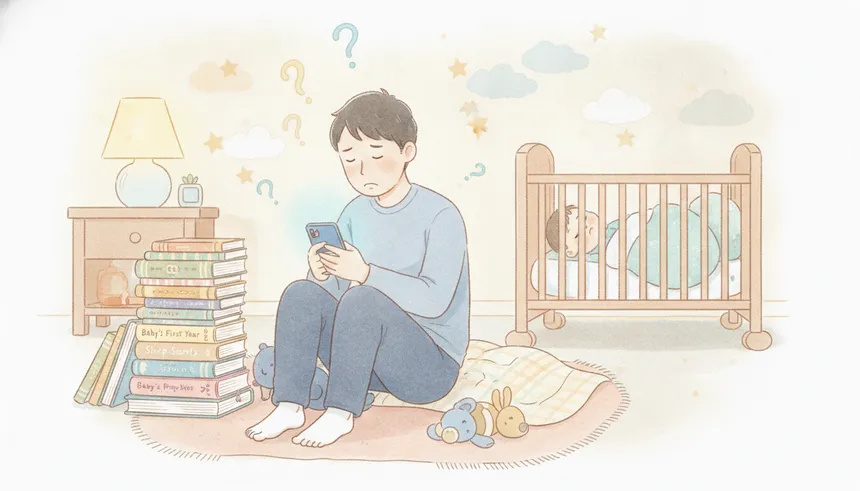
午前3時。片手で赤ちゃんをとんとんしながら、もう片方の手で検索していました。
「離乳食 いつから」「夜泣き いつまで」「湿疹 アレルギー」
1時間後。手元に残っていたのは、知識ではなく不安でした。
この反省から、一度ちゃんと調べてみることにしました。アジアや日本の乳児に関する研究と、WHOやAAPのガイドラインを、整理してみたんです。
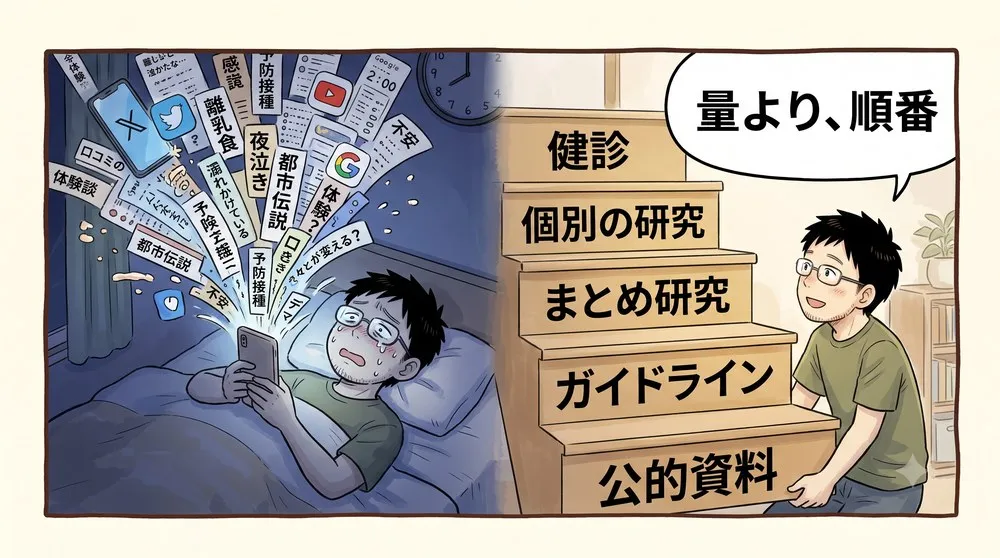
そしてわかったのは、問題は情報の量でなく順番だったということでした。
目次
なぜ夜中の検索は、不安しか残らないのか?
原因は、種類の違う情報をごちゃ混ぜに読んでいたことでした。
育児の情報には、役割がはっきり分かれています。
- 公的資料(母子健康手帳、こども家庭庁、厚生労働省、JIHS)……今日やることを決める
- ガイドライン(WHO、AAP、学会)……原則を押さえる
- 系統的レビュー(Cochraneなど)……全体の傾向を知る
- コホート研究(JECSなど)……自分の状況に近いかを見る
- 健診とかかりつけ医……うちの子の話にする
夜中の僕は、この5つを全部同じ重さで読んでいました。それでは決まるはずがない。
逆に、この順番で使い分けると、「すぐ行動するための情報」と「背景を知るための情報」を混同しなくなる。これが今回一番役に立った発見でした。
月齢ごとに、どこを見ればいいのか?
調べていて、月齢によって「使うべき資料の種類」が変わるのもわかりました。
| 時期 | よくある問い | まず見るもの |
|---|---|---|
| ~生後1か月 | 何を準備するか、寝かせ方、気になるサイン | 母子健康手帳、育児のしおり |
| 1〜2か月 | ワクチンの開始、調乳 | JIHSのスケジュール、厚労省の食品安全情報 |
| 3〜4か月 | 体重の増え方、睡眠、同室・添い寝 | 健診、AAPの安全な睡眠 |
| 5〜6か月 | 離乳開始、鉄不足、アレルゲン | WHOの補完食ガイドライン、小児科 |
| 7〜9か月 | 食べムラ、湿疹、事故予防 | 日本の食物アレルギーガイドライン、事故予防資料 |
| 10〜12か月 | 家族の食事へ、言葉かけ、発達 | WHOの発達ガイドライン、健診 |
完璧にやる必要はないと思います。ただ、今の悩みがどの段の話なのかがわかると、検索の手が止まります。
このシリーズで書いたこと
調べたことを、5つに分けて書きました。全部、うちで実際に揉めたテーマです。
- ハチミツ禁止と70℃のお湯。0歳の食事、「絶対」は実は数えるほどだった
- 育児本を無言で閉じた話。予防接種のスケジュールは、今日の公式が正しい
- 添い寝をやめろとは書いていなかった。安全なねんね環境の話(真面目回)
- 「保湿しとけばアレルギーにならない」は、単純すぎた。湿疹と食物アレルギーの話
- 話せない相手に話しかける意味。102件の試験結果が出した答え
ちなみに、一番意外だったのはアレルギーの回です。信じていたことがひとつ壊れました。

つまり、僕に足りなかったのは検索の時間じゃなくて、読む順番だったという話です。
まとめ
育児の情報は、量を増やすと不安が増える。順番を決めると、意外と楽になりました。
なお、この記事を書いているのも深夜です。人は学びません。
※このシリーズは、一人の父親が論文と公的資料を読んで整理したもので、診断や治療の代わりにはなりません。判断に迷ったときは、必ず健診やかかりつけの小児科で相談してください。また、予防接種など制度に関わる情報は変更されるので、必ず最新の公式情報をご確認ください。
主な参照先:こども家庭庁(母子健康手帳・健診)・厚生労働省(食品安全・予防接種)・WHO(補完食・発達)・AAP(安全な睡眠)・Cochrane・JECS。
All My 3 a.m. Searching Left Me Was Anxiety: A Reading Order for Parenting Information
3 a.m. One hand patting the baby back to sleep, the other hand searching.
“when to start solids” “night crying how long” “baby eczema allergy”
An hour later, what I was left holding wasn’t knowledge. It was anxiety.
That stung enough that I decided to do the research properly, just once. I went through studies on infants in Asia and Japan, along with the WHO and AAP guidelines, and tried to sort it all out.
And here’s what I found: the problem was never the amount of information. It was the order.
Table of Contents
- Why does searching in the middle of the night leave you with nothing but anxiety?
- Which resources should you check at each age?
- What this series covers
Why Does Searching in the Middle of the Night Leave You With Nothing but Anxiety?
The cause: I was reading completely different kinds of information all jumbled together.
Parenting information actually divides cleanly by role.
- Official resources (the Maternal and Child Health Handbook, the Children and Families Agency, Japan’s Ministry of Health, Labour and Welfare (MHLW), JIHS) — for deciding what to do today
- Guidelines (WHO, AAP, medical societies) — for getting the principles down
- Systematic reviews (Cochrane and the like) — for seeing the overall trend
- Cohort studies (JECS and others) — for checking how close the evidence is to your own situation
- Checkups and your regular pediatrician — for turning all of it into a conversation about your own child
The 3 a.m. version of me was reading all five with exactly the same weight. No wonder nothing ever got decided.
Flip that around and use them in this order, each for its own job, and you stop confusing “information for acting today” with “information for understanding the background.” That was the single most useful discovery of this whole exercise.
Which Resources Should You Check at Each Age?
Something else became clear along the way: the kind of resource you should reach for changes with your baby’s age.
| Age | Common questions | Check first |
|---|---|---|
| Up to 1 month | What to prepare, how to lay baby down to sleep, signs to watch for | Maternal and Child Health Handbook, parenting guide booklets |
| 1–2 months | Starting vaccinations, preparing formula | The JIHS vaccination schedule, MHLW food-safety information |
| 3–4 months | Weight gain, sleep, room-sharing and co-sleeping | Well-baby checkups, the AAP’s safe sleep recommendations |
| 5–6 months | Starting solids, iron deficiency, allergens | WHO complementary feeding guidelines, your pediatrician |
| 7–9 months | Hit-or-miss eating, eczema, injury prevention | Japan’s food allergy guidelines, injury-prevention resources |
| 10–12 months | Moving toward family meals, talking to your baby, development | WHO developmental guidelines, well-baby checkups |
I don’t think you need to do this perfectly. But once you can tell which step of the staircase today’s worry belongs to, the compulsive searching just stops.
What This Series Covers
I wrote up what I found in five posts. Every single one is a topic that caused an actual argument in our house.
- The Honey Ban and 70°C Water: In Baby’s First Year of Eating, the True “Absolutes” Turn Out to Be Surprisingly Few
- The Day I Silently Closed the Parenting Book: For Vaccine Schedules, Today’s Official Source Is the Right One
- It Never Actually Said “Stop Co-Sleeping”: A Look at Safe Sleep Environments (a Serious One)
- “Just Moisturize and They Won’t Get Allergies” Was Too Simple: On Eczema and Food Allergy
- Why Talk to Someone Who Can’t Talk Back? The Answer From 102 Trials
For the record, the one that surprised me most was the allergy post. One thing I had believed got quietly dismantled.

So, the moral: what I was short on wasn’t search time. It was a reading order.
Wrapping Up
With parenting information, piling on more volume just piles on more anxiety. Settling on an order made things surprisingly easier.
Incidentally, I am writing this post in the middle of the night. People never learn.
Note: This series is one dad’s attempt to organize what he learned from research papers and official resources; it is no substitute for diagnosis or treatment. Whenever you are unsure, always ask at your baby’s checkup or consult your regular pediatrician. Also, information tied to official programs, such as vaccinations, changes over time, so always check the latest official sources.
Main references: Children and Families Agency (Maternal and Child Health Handbook, checkups) · Japan’s Ministry of Health, Labour and Welfare (MHLW) (food safety, vaccinations) · WHO (complementary feeding, development) · AAP (safe sleep) · Cochrane · JECS.